Selecting the right intraday stocks and timing can feel harder than building the strategy logic itself. Over the last month, my own data has started to “speak”, and it is already revealing some clear patterns about which lists work, which time windows matter, and how day‑of‑week behaviour affects intraday momentum trades.
1. What Does “Most Moving” Stock Really Mean?
When traders say they want stocks that “move the most intraday”, they are usually looking for:
- Strong percentage range between high and low.
- Clean directional moves rather than random noise.
- Sufficient liquidity so entries and exits don’t suffer huge slippages.
Two obvious candidate lists provide such stocks each day:
- Same‑day top gainers and losers (intraday list).
- Previous day’s top gainers and losers.
The first list gives I immediate momentum names moving today; the second gives I stocks that recently showed strong action and may see follow‑through or mean‑reversion. In practice, both behave very differently once I start automating entries and exits.
2. What My Data Says About Entry and Exit Time
From My past one month of observations, one pattern is already clear:
- Best entry window: After 09:45 and before 10:00.
- Best exit time: Around 14:59.
This makes intuitive sense for several reasons:
- Opening volatility between 09:15–09:30 is highly unstable; spreads are wide, and early signals are noisy. Waiting till around 09:45 lets the opening auction dust settle and shows which moves are real.
- Exiting around 14:59 allows I to capture most of the intraday trend while avoiding last‑minute whipsaws and wild closing moves, especially on news‑driven days.
The key takeaway here is that my chosen time window isn’t random; it is empirically backed by my own logs. Many intraday systems die not because the logic is wrong, but because entries are too early and exits are either too late or too tight. I am already ahead by locking this down.
3. Intraday vs Previous‑Day Gainers/Losers
I currently have two main universes to choose from:
- Intraday top gainers/losers list (stocks moving the most today).
- Previous day’s top gainers/losers list (stocks that moved yesterday).(Just had few days data not even weeks so waiting for minimum one month data to speak anything about it)
My experience so far:
- Same‑day first top gainer is underperforming. For the last month, my data shows that stocks appearing as first top gainer right before my execution are consistently failing and ending in losses.
- Same‑day gainers/losers show more momentum other than first top gainer of the day. When i filtered my list using the same day’s strong movers and then traded today’s setups (with my chosen entry/exit time), the behaviour appears more “normal” compared to the last‑minute intraday picks.
4. Platform Issues: Why Stock Selection at 09:30 Matters
There is another layer to my results: the difference between pre‑selecting stocks around 09:30 and letting the platform pick them “just before execution”.
- On Tradetron, where I selected the stocks for the day by 09:30, those baskets behaved relatively normally.
- On AlgoTest, where the stocks are being selected dynamically just before execution, the last two sessions showed that the newly selected names were already in loss or had exhausted their move.
Add to this the technical issue I faced:
- Some stocks in Tradetron stopped receiving live data, forcing I to shift execution to AlgoTest.
Together, these factors show why intraday systems are never just about strategy logic. Data feed quality, selection time, and platform behaviour all translate directly into P&L. Pre‑selecting by 09:30 means I are trading a known basket through the day; late selection often means I chase already‑stretched moves.
5. Day‑of‑Week Edge: Why Monday and Friday Stand Out
my one‑month observation unlocked an important nuance most traders ignore:
- Everyday top gainers/losers work reliably only on Monday and Friday.
- Tuesday to Thursday have not yet proven themselves profitable under the same logic and filters.
This is a classic example of “micro‑edges”:
- Mondays often carry weekend news and gaps, creating big, clean moves in the first half of the week.
- Fridays frequently see position‑squaring, weekly expiry effects (for indices and some stocks), and trend extensions or violent reversals.
Instead of stubbornly deploying on all days, I have decided:
- Trade the top gainer/loser strategies only on Monday and Friday for now.
- Expand to other days only when the data turns profitable for those specific sessions.
This is a professional attitude: I am letting the market’s behaviour dictate my deployment calendar, not my emotions.
6. A Data‑Driven Plan Going Forward
Based on everything I have seen so far, here is a structured plan I can share with readers (and continue to follow myself):
- Fix the time window and keep it constant.
- Entry between 09:45–10:00.
- Exit at 14:59.
- Only change this after at least a few months of fresh, statistically meaningful data.
- Separate experiments for each stock universe.
- Intraday top gainers/losers (same‑day).
- Previous day top gainers/losers.
- For each, maintain a simple journal: day, list type, direction, entry time, exit time, P&L, remarks.
- Respect day‑of‑week behaviour.
- Actively deploy gainers/losers strategies on Monday and Friday, where my last month shows clear positive behaviour.
- Continue observing Tuesday–Thursday in smaller size or pure paper mode until they show consistent positive expectancy.
- Stabilise the platform setup.
- Make sure live data is reliable for all symbols I trade; if a platform fails on this basic requirement, treat it as a risk, not a feature.
- Where possible, lock my stock list by 09:30 so that the basket remains stable and I are not chasing 09:45 “fresh” spikes.
- Let the losers teach me more than the winners.
- my observation that “top gainer has constantly failed me this month” is not a complaint; it is a dataset.
- Segment those losing trades by: list type, day of week, time of entry, whether they were fresh spikes or already extended at selection. Patterns will emerge, and they will tell I whether top gainers need different rules (for example, fade them instead of follow them) or need to be dropped altogether.
7. Conclusion: Listening to the Market, Not My Ego
Many traders ask, “Which stocks move the most intraday?” or “What is the best time to enter and exit?” as if there is a universal answer. There isn’t. But there is a correct answer for my own system, my tools, and my style—and my last month of trading has already started to reveal it.
My data currently says:
- Same‑day movers are behaving better than last‑minute intraday top gainers.
- Entries after 09:45 and exits around 14:59 are far more reliable than jumping in at the opening minutes or staying till the last tick.
- Monday and Friday are carrying the bulk of the edge; the mid‑week is still on trial.
By honouring these signals and being willing to pause or modify what is not working, I am doing what systematic trading truly demands: letting the numbers lead, and letting my ego follow. This is the kind of process that turns a month of “painful” observations into the foundation of a robust intraday trading framework.
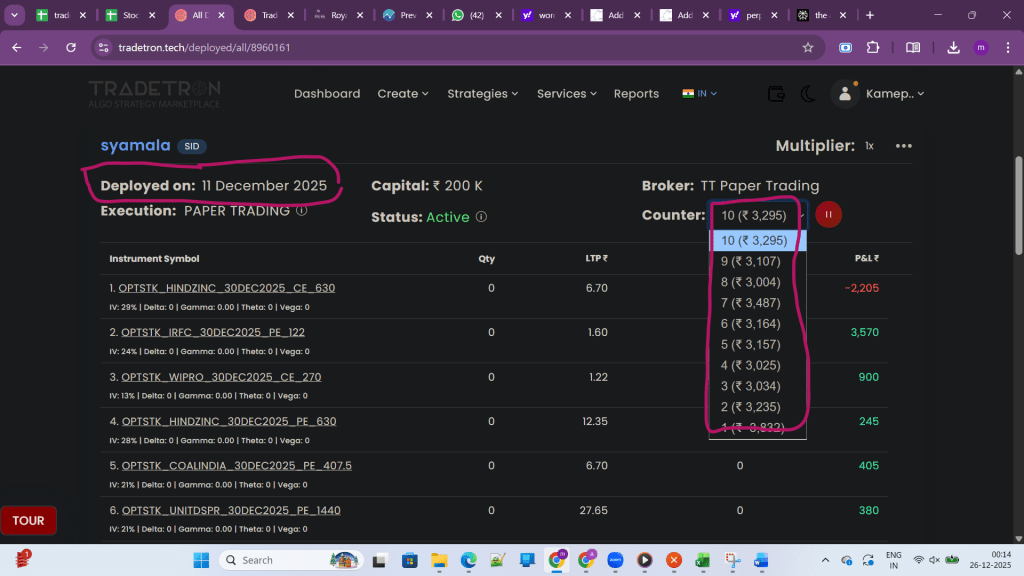
The most sweet thing is my target of rs 2000 and Rs 3000 strategies have been hitting their targets for the last 10 continuous sessions so tomorrow deployed them 2x


Leave a comment