Category: Uncategorized

  • When Execution Teaches Hard Lessons: A Trader’s Honest Reflection and a Stronger Comeback

    Last week was one of those weeks that every serious algorithmic trader inevitably faces—not because the strategy failed, but because execution exposed weak links in the process.

    I believe it’s important to share not only success stories, but also the mistakes, learnings, and corrections that shape long-term consistency. This blog is exactly that.


    Issue 1: Combined Buy & Sell Legs — A Costly RMS Lesson

    In one of my strategies, I was deploying buy and sell legs together for a stock. On paper, the logic was sound.
    But in live execution, a critical issue surfaced:

    • One leg got executed successfully
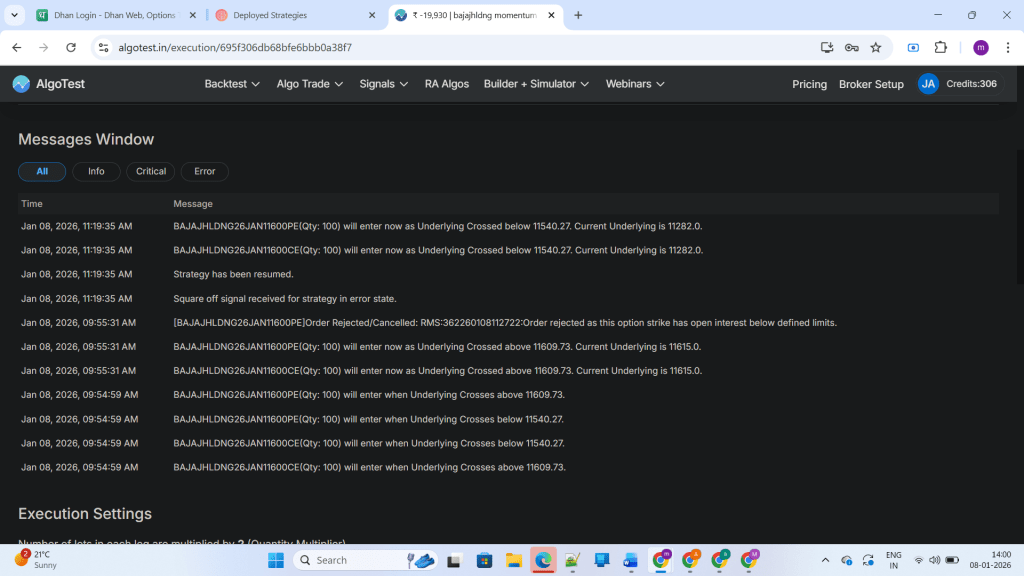
    • The other leg got rejected due to RMS (Risk Management System) constraints
    • The strategy moved into an error state
    • As a result:
      • Stop-losses were not carried
      • Targets were not placed
      • The open position became unmanaged

    📉 Outcome:
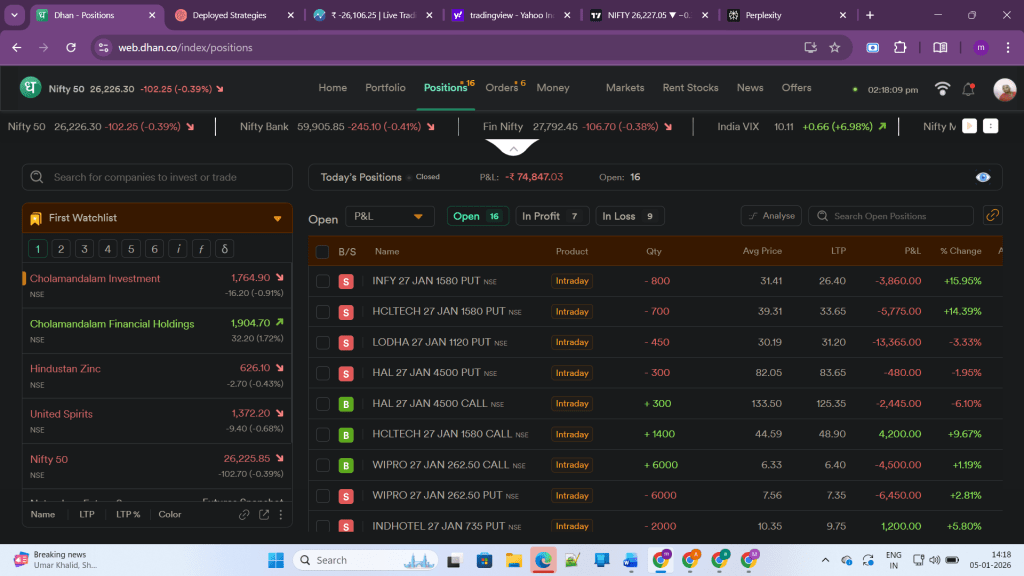
    A loss of nearly ₹20,000 in a single stock—not due to strategy logic, but due to execution dependency.

    ✅ The Fix Implemented

    I immediately redesigned the execution logic:

    • Buy legs and sell legs are now deployed separately
    • Each leg is independently monitored
    • Even if RMS rejects one side, the other leg remains protected
    • Stop-loss and target placement is now non-negotiable

    This change has eliminated single-point execution failure.


    Issue 2: Human Error — Deploying 4 Stocks Instead of 8

    On another trading day, the strategy performed exceptionally well.
    However, due to an execution oversight:

    • I deployed the strategy on only 4 stocks instead of the usual 8
    • The market rewarded the setup perfectly

    📈 Missed Opportunity:
    Approximately ₹30,000 in unrealized profit, purely because of incomplete deployment.

    ✅ The Fix Implemented

    To prevent this from ever repeating:

    • I now religiously cross-check the number of stocks deployed every single day
    • A fixed pre-market and post-deployment checklist is followed
    • No strategy is considered “live” unless all intended stocks are confirmed

    Process discipline is now as important as strategy logic.


    What These Experiences Reinforced

    These incidents didn’t weaken the system—they strengthened it.

    They reinforced three core truths of professional algo trading:

    1. Execution matters as much as strategy
    2. Small process gaps can cause large financial impact
    3. Immediate correction is the hallmark of a serious trader

    Instead of ignoring these mistakes, I embraced them, fixed them, and upgraded the system.


    Looking Ahead: Focused, Corrected, and Ready

    With:

    • Separated buy/sell leg execution
    • RMS-safe logic
    • Strict deployment verification
    • Daily discipline in execution checks

    I step into the coming week with confidence, clarity, and caution—the right combination for sustainable returns.

    Markets will do what they always do.
    What matters is that my systems are now better prepared.

    📊 Looking ahead to next week for strong, controlled returns.
    Let’s see what the market brings—this time with sharper execution and stronger safeguards.


    Final Thought

    Losses teach.
    Missed profits remind.
    Corrections build consistency.

    This is not just trading.
    This is evolution.

    Madhu Babu

    When Execution Teaches Hard Lessons: A Trader’s Honest Reflection and a Stronger Comeback

    Last week was one of those weeks that every serious algorithmic trader inevitably faces—not because the strategy failed, but because execution exposed weak links in the process.

    I believe it’s important to share not only success stories, but also the mistakes, learnings, and corrections that shape long-term consistency. This blog is exactly that.


    Issue 1: Combined Buy & Sell Legs — A Costly RMS Lesson

    In one of my strategies, I was deploying buy and sell legs together for a stock. On paper, the logic was sound.
    But in live execution, a critical issue surfaced:

    • One leg got executed successfully
    • The other leg got rejected due to RMS (Risk Management System) constraints
    • The strategy moved into an error state
    • As a result:
      • Stop-losses were not carried
      • Targets were not placed
      • The open position became unmanaged

    📉 Outcome:
    A loss of nearly ₹20,000 in a single stock—not due to strategy logic, but due to execution dependency.

    ✅ The Fix Implemented

    I immediately redesigned the execution logic:

    • Buy legs and sell legs are now deployed separately
    • Each leg is independently monitored
    • Even if RMS rejects one side, the other leg remains protected
    • Stop-loss and target placement is now non-negotiable

    This change has eliminated single-point execution failure.


    Issue 2: Human Error — Deploying 4 Stocks Instead of 8

    On another trading day, the strategy performed exceptionally well.
    However, due to an execution oversight:

    • I deployed the strategy on only 4 stocks instead of the usual 8
    • The market rewarded the setup perfectly

    📈 Missed Opportunity:
    Approximately ₹30,000 in unrealized profit, purely because of incomplete deployment.

    ✅ The Fix Implemented

    To prevent this from ever repeating:

    • I now religiously cross-check the number of stocks deployed every single day
    • A fixed pre-market and post-deployment checklist is followed
    • No strategy is considered “live” unless all intended stocks are confirmed

    Process discipline is now as important as strategy logic.


    What These Experiences Reinforced

    These incidents didn’t weaken the system—they strengthened it.

    They reinforced three core truths of professional algo trading:

    1. Execution matters as much as strategy
    2. Small process gaps can cause large financial impact
    3. Immediate correction is the hallmark of a serious trader

    Instead of ignoring these mistakes, I embraced them, fixed them, and upgraded the system.


    Looking Ahead: Focused, Corrected, and Ready

    With:

    • Separated buy/sell leg execution
    • RMS-safe logic
    • Strict deployment verification
    • Daily discipline in execution checks

    I step into the coming week with confidence, clarity, and caution—the right combination for sustainable returns.

    Markets will do what they always do.
    What matters is that my systems are now better prepared.

    📊 Looking ahead to next week for strong, controlled returns.
    Let’s see what the market brings—this time with sharper execution and stronger safeguards.


    Final Thought

    Losses teach.
    Missed profits remind.
    Corrections build consistency.

    This is not just trading.
    This is evolution.

    Madhu Babu

  • 🚀 LIVE ALGO OPTIONS STRATEGIES | TRANSPARENT & RULE-BASED 🚀

    Tired of manual errors, emotional trades, and random tips?
    Step into disciplined, automated Options trading with live shared access.

    Below are my actively shared Tradetron Algo Strategies, designed with diversification, defined risk, and systematic execution.

    🔥 LIVE STRATEGIES (WITH SHARED CODES)
    1️⃣ Alpha Exit – 40 Stock Options Buy
    🔹 SL: ₹15,000
    🆔 Shared Code: ea968d75-1354-481f-8024-08ebbcc4cfb2

    2️⃣ Nifty 100 Green Basket – Selective Days Algo
    🔹 94 Stocks
    🆔 Shared Code: Ac6d799d-ec30-4038-a270-c12dafce463d

    3️⃣ Balanced Target – 55 Stock Options Buy
    🔹 Target: ₹3,000 | SL: ₹4,000
    🆔 Shared Code: 6ba65169-bccb-42ba-9c86-4bf9c3e671e3

    4️⃣ No Target Defender – 50 Stock Options Buy
    🔹 No Target | Overall SL: ₹10,000
    🆔 Shared Code: 0b0b1584-1ed8-4903-b225-032d4f0507e7

    5️⃣ Nifty Power Basket – 94 Stocks Leg-wise SL
    🔹 Target: ₹3,000 | Only Leg-wise SL
    🆔 Shared Code: C311b260-50fd-4df2-8a1c-f2bdfeacb449

    6️⃣ Low Drawdown Builder – 30 Stock Options Buy
    🔹 Target: ₹2,000 | No Overall SL | Leg-wise SL
    🆔 Shared Code: B9366b4b-8c03-46aa-916e-cde3f780b9f0

    7️⃣ Quick Exit Engine – 55 Stock Options Buy
    🔹 No Overall SL | Leg-wise SL
    🆔 Shared Code: 023f0adb-9d1d-42fc-852f-638d829935e6

    8️⃣ Mid Target Performer – 30 Stock Options Buy
    🔹 Target: ₹3,000 | No Overall SL | Leg-wise SL
    🆔 Shared Code: 99e27717-f1db-46fd-aa5b-bbd6264dc257

    9️⃣ Aggressive Alpha – 55 Stock Options Buy
    🔹 Target: ₹3,000 | SL: ₹6,000
    🆔 Shared Code: a3f6933b-3e79-4ad3-98d1-ff273d98b3f2

    🔟 Controlled Risk Pro – 50 Stock Options Buy
    🔹 Overall SL: ₹4,000
    🆔 Shared Code: 1b322b3e-efb7-4892-98b8-92a6ea95dc0d

    1️⃣1️⃣ High Target Momentum – 30 Stock Options Buy
    🔹 Target: ₹4,000 | No Overall SL | Leg-wise SL
    🆔 Shared Code: 785aa29b-c5c3-46bb-acbb-ea32e24ab5bf

    1️⃣2️⃣ Open Basket Strategy – 41 Stock Options Buy
    🔹 No Overall Target | No Overall SL
    🆔 Shared Code: 745bf70e-481b-4ffd-b586-4052dcf3ae2d

    1️⃣3️⃣ Safe Exit Alpha – 40 Stock Options Buy
    🔹 SL: ₹10,000 | No Target
    🆔 Shared Code: D7c2bd61-1599-4f01-a04c-2fa0c04a802c

    💡 Why Subscribers Choose These Strategies

    ✅ Multi-stock diversification (upto 8 stocks)
    ✅ Fully rule-based & automated execution
    ✅ Live shared codes = complete transparency
    ✅ Designed for sideways & volatile markets
    ✅ Focus on process over predictions

    ⚠️ IMPORTANT DISCLAIMER
    Options & Algo trading involves high risk.
    Profits are not guaranteed; drawdowns are part of trading.
    Execution delays, slippage, or platform issues may occur.
    These strategies are for educational purposes only, not investment advice.
    Trade only with capital you can afford to lose.

    📩 Interested in Access?
    DM me for subscription details.

    📈 Automation builds discipline. Risk management ensures survival.
    — Madhu Babu
  • 📌 A Real-World Algo Trading Reality: One Trade Executed, One Trade Rejected

    Dear Traders & Subscribers,

    Today I want to openly share an important live trading incident that happened in my account, because transparency is a core value of how I run and share my strategies.

    This is not a complaint post, not a justification, and not an excuse.
    This is a reality check of algo trading through demat accounts in live market conditions.


    🔍 What Exactly Happened?

    • Same broker: Dhan
    • Same underlying: Bajaj Holdings
    • Same strike: 11600 PE
    • Same expiry
    • Same market session
    • Time difference: barely 4 minutes

    But…

    • Order placed via Tradetron → Executed successfully
    • Order placed via Algotest → Rejected

    The rejection message received was:

    “Order rejected as this option strike has open interest below defined limits.”

    This rejection eventually resulted in a missed opportunity of ~₹40,000.


    🧠 The Confusion Everyone Faces

    After this incident, I heard multiple explanations from different sides:

    • Some say liquidity issue
    • Some say broker RMS (Risk Management System)
    • Some say exchange-level OI limits
    • Some say algo platform handling
    • Some say timing & order routing

    👉 The truth is:
    Retail algo traders don’t always get one single clear answer immediately.

    And that itself is part of live trading reality.


    ⚠️ Important Point to Understand

    This was NOT:

    • A strategy failure
    • A logic error
    • A wrong signal
    • A manual execution mistake

    This was a system-level rejection, something that can happen when:

    • OI thresholds dynamically change
    • RMS checks vary by microseconds
    • Exchange risk filters activate suddenly
    • Platforms route orders differently even with the same broker

    Algo trading is not a backtest environment.
    Live markets are messy, fast, and imperfect.


    🧩 Why One Platform Worked and the Other Didn’t?

    This is the most common question.

    Even when:

    • Broker is same
    • Instrument is same
    • Strike is same

    👉 Order routing, validation timing, RMS checks, and exchange responses can differ between platforms.

    A few minutes, few seconds, or even milliseconds can make a difference.

    This is not widely discussed on social media—but it’s the truth.


    📣 My Stand as of Now

    • I have raised this issue with Algotest
    • Their team is investigating the root cause
    • I am not jumping to conclusions
    • I am not changing broker or platform in panic
    • I am continuing trading as usual

    Why?

    Because professional trading is about handling uncertainty, not running away from it.


    💡 What I Want Subscribers to Take Away

    1. Algo trading is powerful, but not perfect
    2. Execution risks exist, even with the best setup
    3. Losses can come from systems, not strategies
    4. Risk management must include execution risk
    5. Emotional decisions after one incident are dangerous

    Today it cost me money.
    Tomorrow it might save me money.

    This is the game.


    🤝 Transparency Above Everything

    I believe trust is built when realities are shared, not just profits.

    You are not following a fantasy system.
    You are following real strategies traded in real accounts with real challenges.

    I will update you once I get clarity from Algotest.
    Until then, we trade calmly, logically, and professionally.


    Final Thought

    Markets don’t reward perfection.
    They reward those who survive imperfections.

    Thank you for standing with me in both profits and realities.

    Madhu Babu
    Algo Trader | Strategy Developer | Real Market Participant

  • Consistently Target-Hitting Algo Strategies – Live & Transparent


    Dear Subscribers,

    I hope you’re doing well.

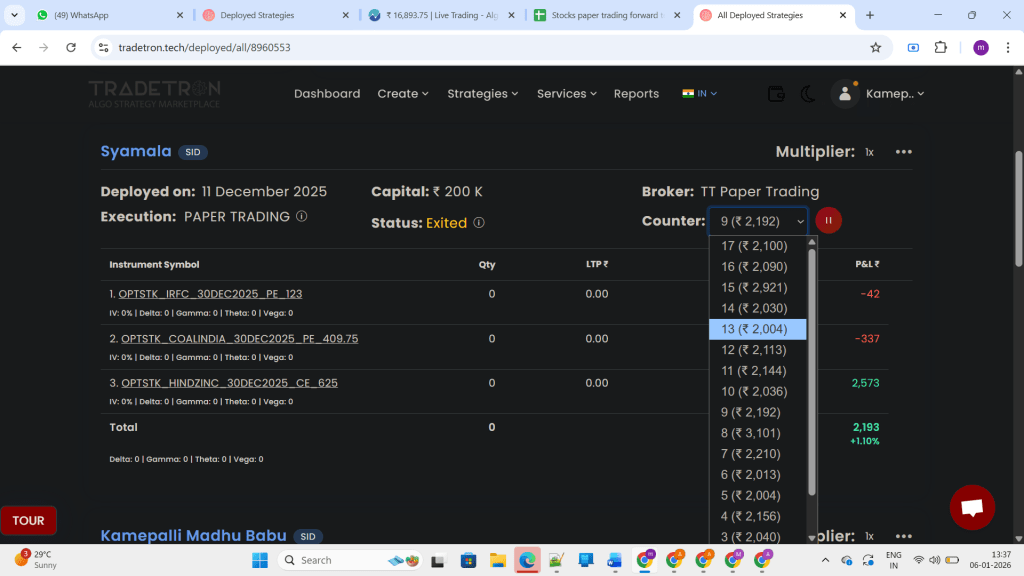
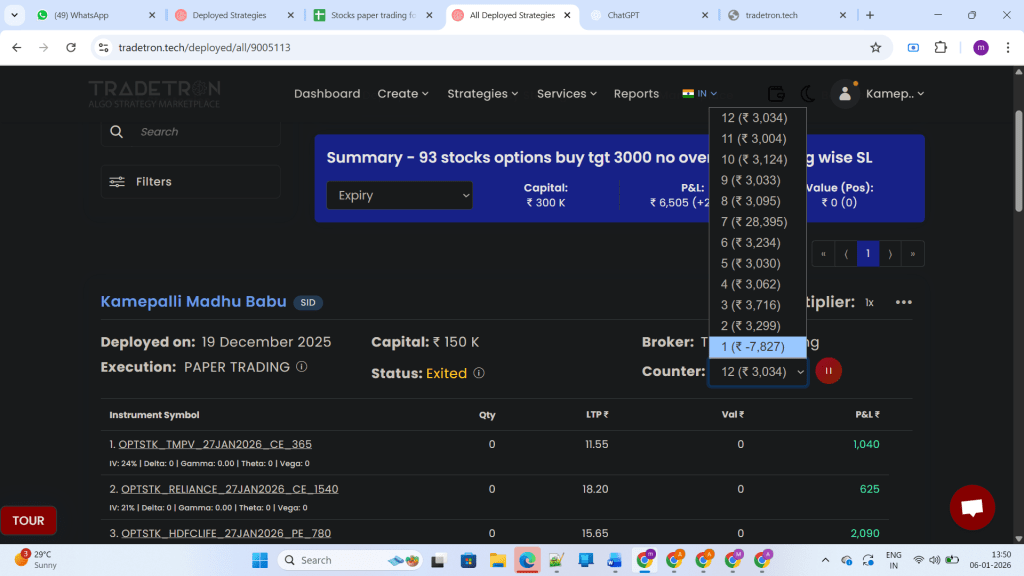
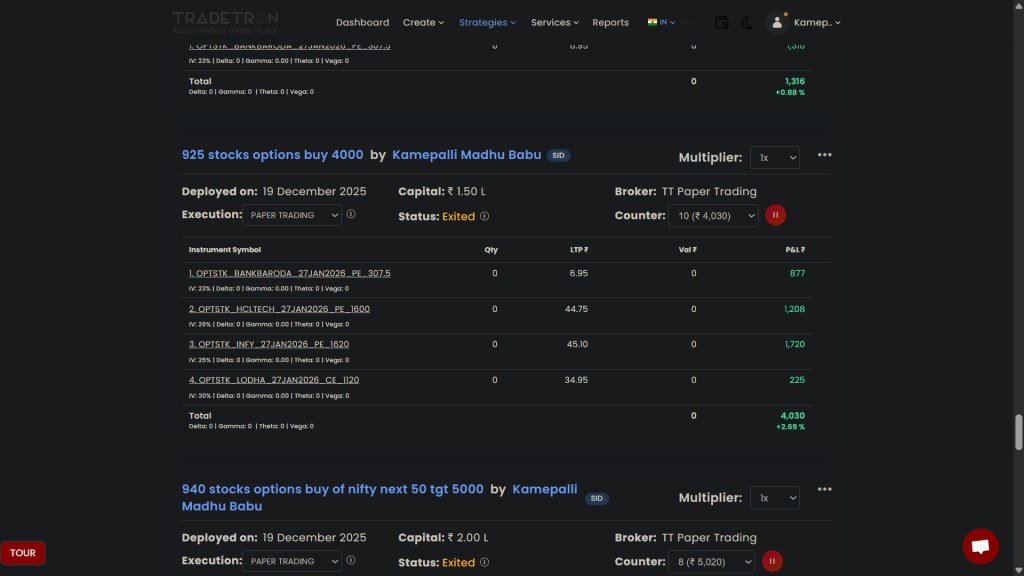
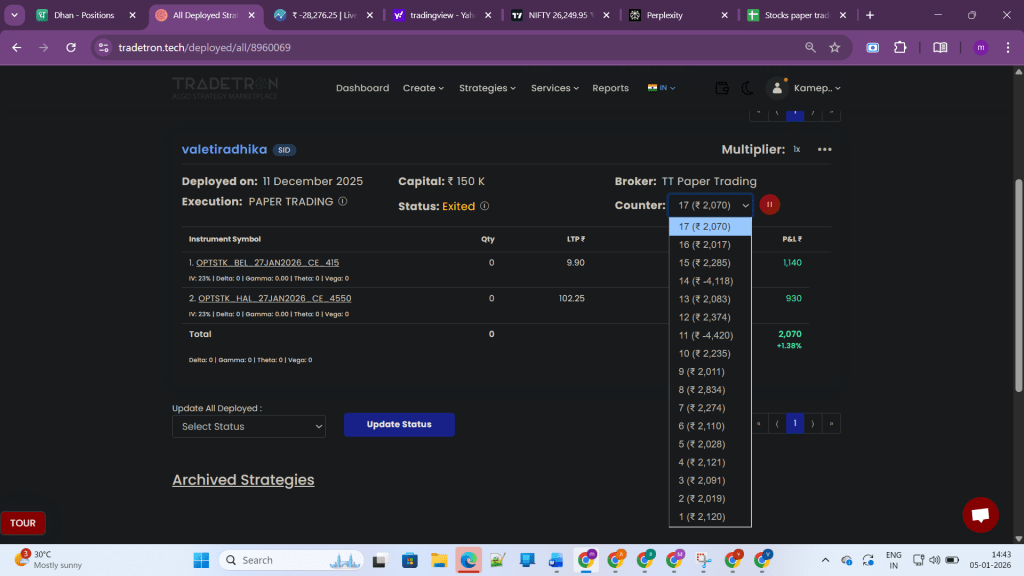
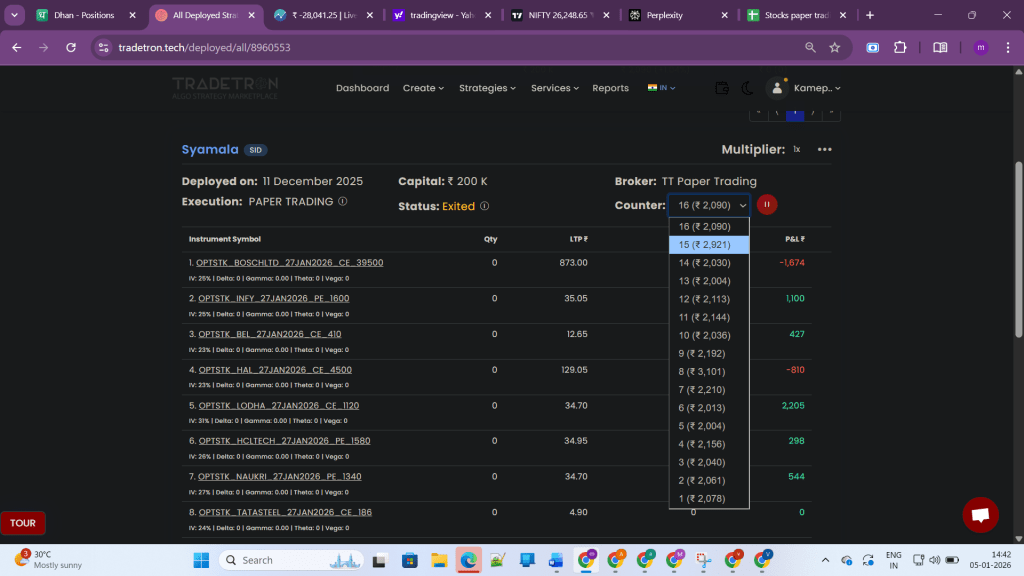
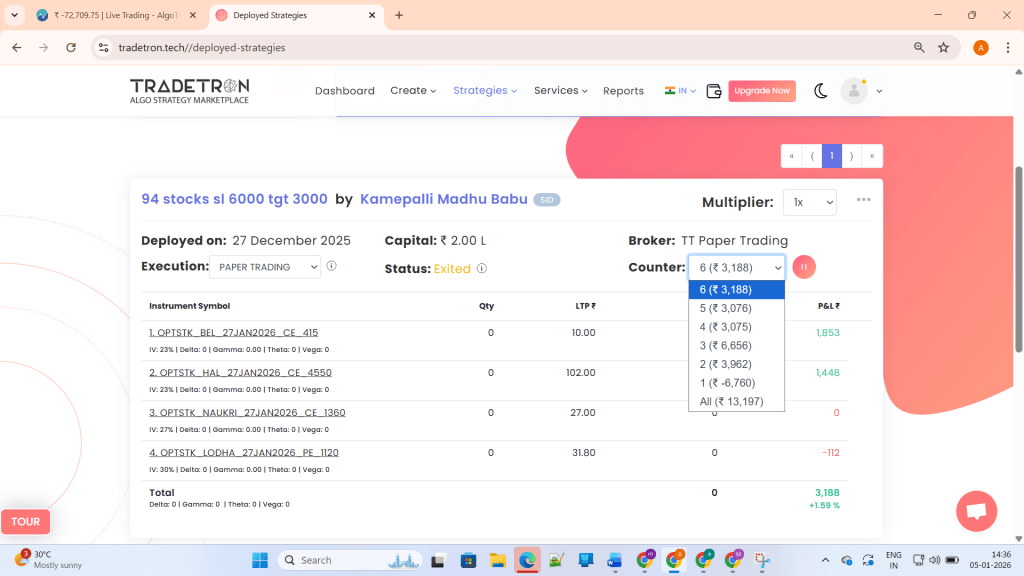
    I’m reaching out to invite you to deploy a set of my consistently target-hitting option strategies that have been performing with discipline and clarity across recent market conditions.

    Over the past sessions, these strategies have demonstrated:

    • Consistent target achievements
    • 📊 Rule-based execution with controlled risk
    • 🔁 Repeatable performance across multiple stocks
    • 🧠 No discretionary interference – pure system-driven trades

    For your complete transparency and confidence, I’m enclosing:

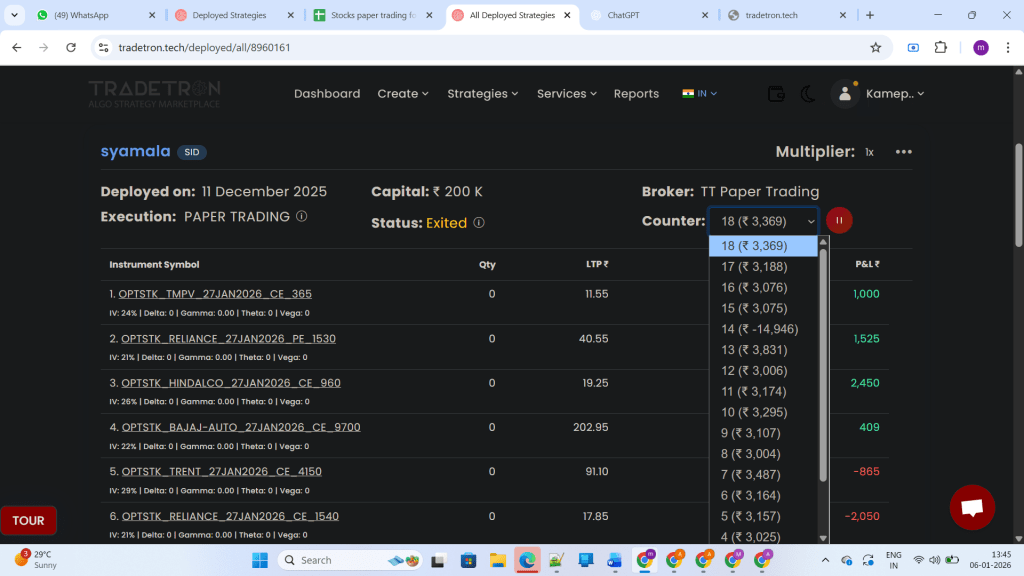
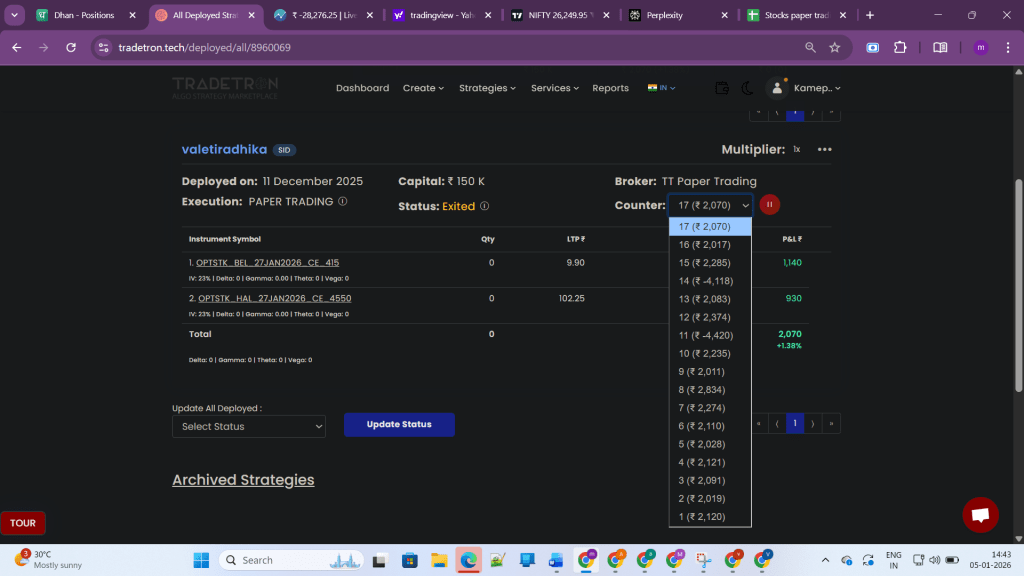
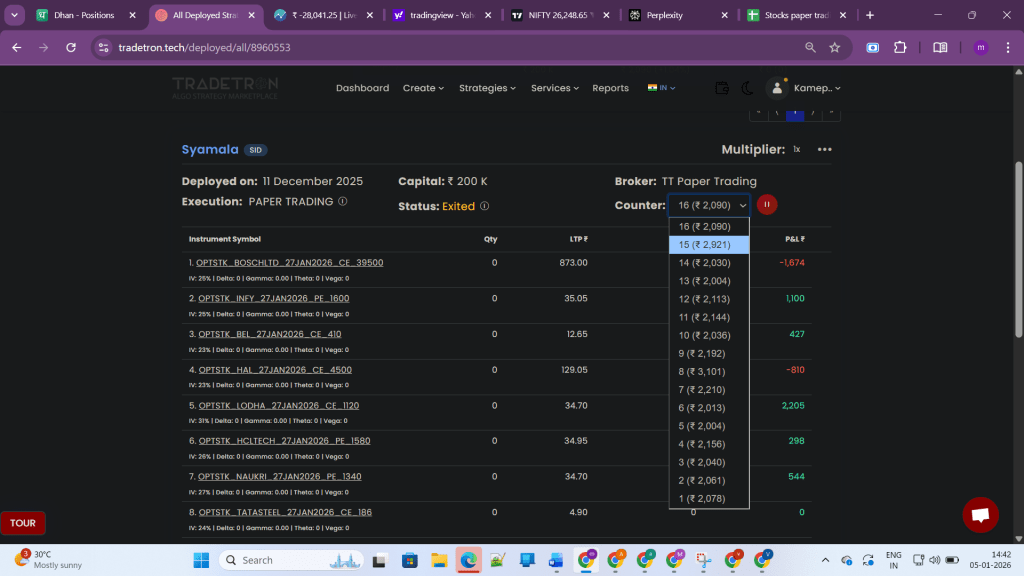
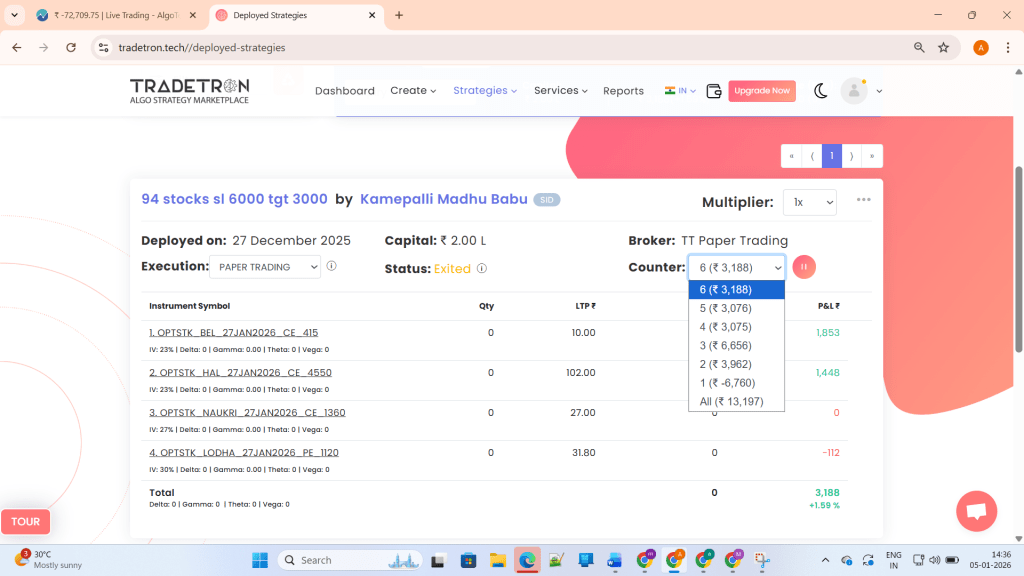
    • 📸 Actual strategy screenshots
    • 🔗 Direct strategy links
    • 🟢 Live shared deployment codes
    • 📈 Detailed strategy statistics & counters

    These are not one-off lucky trades. They are process-driven systems built with a clear understanding of market behavior, volatility, and capital protection. Every entry, exit, and target is pre-defined.

    Why consider deploying these strategies?

    • Designed for consistency over excitement
    • Suitable for traders who value discipline and probability
    • Continuously monitored and refined
    • Fully automated execution support

    ⚠️ Disclaimer:
    All strategies are shared for educational and deployment purposes. Market risks are inherent, and past performance does not guarantee future results. Please deploy only after reviewing the strategy logic and ensuring it aligns with your risk appetite.

    If you believe in process-driven trading and are looking to participate in strategies that respect risk as much as returns, I’d be glad to have you on board.

    Feel free to go through the enclosed details, and I’ll be happy to clarify anything or guide you through deployment.

    Warm regards,
    Kamepalli Madhu Babu
    Algo Strategy Developer & Trader


    https://tradetron.tech/strategy/8960161

    https://tradetron.tech/strategy/9005113

    https://tradetron.tech/strategy/8960069

    https://tradetron.tech/strategy/8960553

    here are the shared codes

    31a67994-2f61-42b5-8683-9e837da4b432

    639826ac-5de6-4db2-a809-0875b4c5f2dc

    597fdb9c-1c08-4db5-b092-43484c5dae9d

    99e27717-f1db-46fd-aa5b-bbd6264dc257

    how to use shared codes video link is provided below

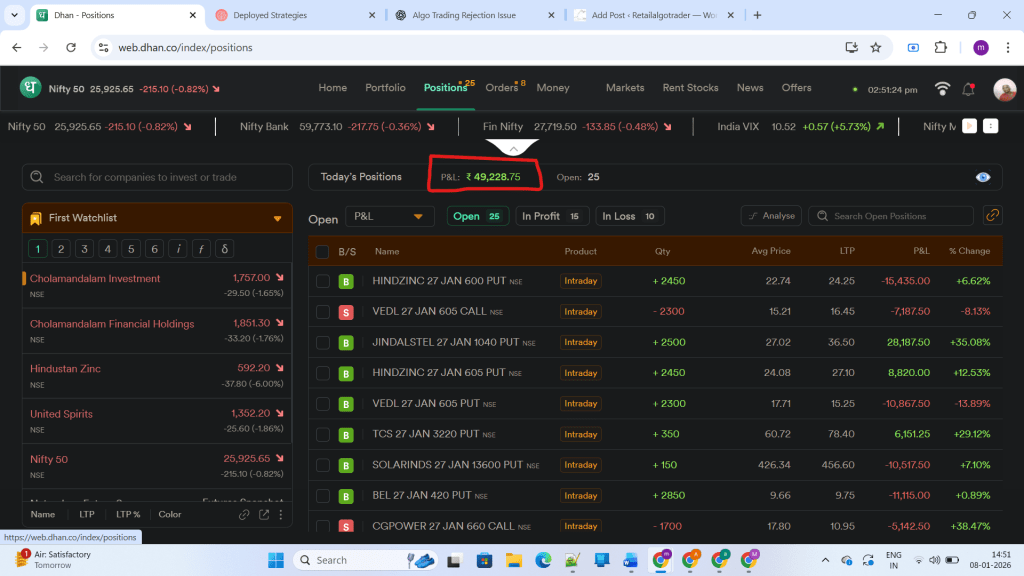
  • Targets Don’t Care About Market Mood

    Date: 05 January 2026
    Market: NIFTY 50 (Sideways Session)


    When the Market Refused to Trend

    Today’s market was anything but generous. The NIFTY moved sideways, lacking conviction, momentum, or follow-through. It was the kind of session where impatience gets punished and overconfidence gets exposed.

    Yet, amid this dull and compressed price action, something important happened.


    The Outcome That Matters

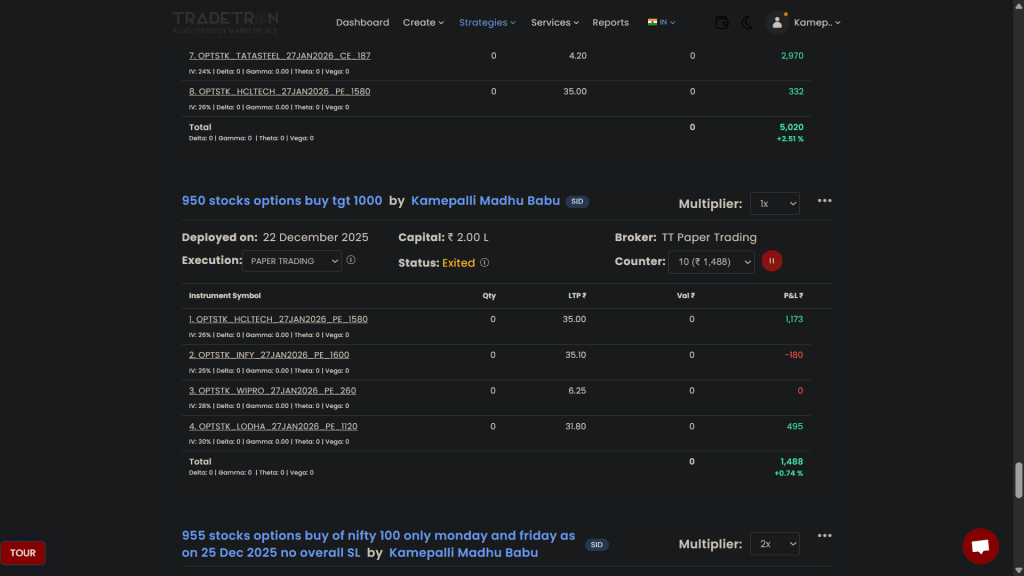
    All predefined targets were hit.

    Not hypothetically. Not on hindsight charts.

    Every single target level—₹2,000, ₹3,000, ₹4,000, and ₹5,000—was achieved today.

    And this deserves to be highlighted clearly:

    These targets were hit in a sideways market, not a trending one.


    Why This Is Significant

    Most traders believe profits come only when markets trend strongly. Days like today prove otherwise.

    This performance was not driven by:

    • Luck
    • Aggressive position sizing
    • Hope-based holding

    It was driven by:

    • Well-defined entry logic
    • Strict risk management
    • Realistic, probability-based targets

    When strategies are designed correctly, they don’t need the market’s mood to cooperate.


    Breaking the Myth: “Sideways = No Money”

    Sideways markets don’t eliminate opportunities.
    They eliminate undisciplined traders.

    Today clearly demonstrated that:

    • Small targets compound
    • Discipline outperforms prediction
    • Process beats emotion

    A Note on Risk and Professionalism

    Equally important is what did not happen today:

    • No overtrading
    • No revenge trades
    • No violation of rules

    Some strategies booked small expenses, as expected in a sideways session—but target-based strategies delivered exactly as designed.

    This balance between booking expenses and booking profits is what keeps the equity curve stable.


    Message to Subscribers

    If you traded today and felt the market was slow, confusing, or boring—remember this:

    The market doesn’t need to trend for disciplined systems to pay.

    What matters is:

    • Trusting the process
    • Respecting position sizes
    • Letting targets do their job

    Today was not about excitement.
    It was about execution.

    And execution delivered.


    Closing Thought

    Markets will have trending days.
    Markets will have sideways days.

    But targets remain targets—independent of noise, news, or narrative.

    Today reaffirmed a simple truth:

    When your system is right, consistency replaces prediction.

    We stay patient.
    We stay disciplined.
    And we keep hitting targets—one session at a time.

    Kamepalli Madhu Babu

  • When the Market Moves Sideways, the Mind Must Move Forward

    Date: 05 January 2026
    Market: NIFTY 50
    Range: 26,373 – 26,264


    A Sideways Day, Honestly Acknowledged

    Today, the broader NIFTY oscillated within a narrow range of 26,373 to 26,264. This is the textbook definition of a sideways market—no momentum, no follow‑through, no generosity for trend‑hunters.

    Equally important to acknowledge: the stocks I selected today also did not display the kind of trending behavior we’ve seen on stronger directional days. This is not a failure of analysis; it is the reality of markets. Markets breathe, pause, and sometimes simply walk instead of run.


    A New Lens: From “Losses” to “Expenses”

    From today onward, I am consciously reframing how we look at red numbers.

    👉 We will no longer call them “losses.”
    👉 We will call them “expenses.”

    Why?

    Because:

    • Expenses are planned
    • Expenses are finite
    • Expenses are necessary to run a business

    Trading is not gambling; it is a business of probabilities. And every business has operating costs—rent, salaries, infrastructure.

    In trading, those operating costs are:

    • Sideways markets
    • Low volatility sessions
    • False breakouts
    • Time decay

    Today, a few strategies gracefully booked expenses. Gracefully—because risk was respected, systems behaved as designed, and capital was preserved for better conditions.

    That is not pain. That is professionalism.


    The Most Important Observation of the Day

    Even in this non‑trending, compressed market environment:

    All of my target‑hit strategies HIT THEIR TARGETS.

    Read that again.

    Not in a trending day.
    Not with strong sectoral moves.
    But in a narrow, sideways market.

    This is the real edge—not predicting direction, but designing systems that can survive indifference.


    What Today Teaches Us (If We’re Willing to Learn)

    1. Sideways days are filters, not enemies
      They filter impatience, overconfidence, and emotional trading.
    2. Strategy diversity matters
      When momentum strategies slow down, probability‑based and target‑focused strategies step up.
    3. Psychology compounds faster than profits
      The moment you stop fearing red numbers and start understanding them, your decision‑making quality improves.
    4. Capital protection is silent success
      The market doesn’t reward you for surviving a bad day—but your equity curve does.

    A Message to My Subscribers

    If today felt boring, uncomfortable, or underwhelming—good.

    That means:

    • You are trading reality, not fantasy
    • You are witnessing how systems behave between trending days
    • You are learning patience, the most expensive skill in markets

    Remember:

    Trends pay the bills. Sideways days test the mindset.

    And today, the mindset held firm.


    Closing Thought

    Markets will not trend every day.

    But disciplined traders don’t need every day to trend.
    They just need:

    • Defined risk
    • Honest execution
    • And the courage to call expenses what they are—the cost of staying in the game.

    We move forward. Calmly. Rationally. Professionally.

    Kamepalli Madhu Babu

  • Diversifying Across Commodities and Indices: My Bold Live Deployment.

    Next week marks a strategic deployment in live algo trading with heavy diversification across natural gas options (14 lots), crude oil options (8 lots), silver futures (2 lots), Nifty index options (7 lots), and stock options (69 lots) across 10 to 14 stocks. Review happens next Saturday to assess profits and losses, but decisions stay data-driven over long-term performance, not weekly swings . Fixed ₹2000-₹3000 target strategies pause in live after booking targets last week but missing bigger gains; forward testing continues with varied SLs and targets .

    Deployment Breakdown

    Positions span MCX commodities and NSE derivatives for balanced exposure.
    This mix reduces correlation risks from past drawdowns in single assets like Nifty and natural gas .

      Forward Testing Fixed Targets

      Strategies hitting ₹2000-₹3000 daily stay in sandbox mode only, observing SL adjustments post-last week’s live. Live capital flows to uncapped versions for full trend capture, aligning with 5+ years of refining data-backed systems . Review post-next week decides scaling, prioritizing equity curves over short bursts .

      Embracing Profits and Losses Alike

      Humongous profit weeks excite sharing; loss weeks less so, but both fuel the business—I believe that losses are as  controlled “expenditures” like buying raw materials before profits roll in . controlled losses build resilience for asymmetric wins in algo trading .every one may not share same beliefs about losses this may not be comfortable me sharing them. That’s why generally I avoid sharing losses. But I must accept proudly that I do book losses but controlled losses

      Past performance does not guarantee future results. Derivatives trading carries substantial risk of capital loss due to volatility, slippage, and margins. Deploy only risk capital , test in paper mode, and consult SEBI-registered advisors. Not investment advice—trade responsibly.

    • The Forward Testing Trap: Why 3 Months Is Never Enough (Lessons from a Natural Gas Strategy That Hit ₹3L Peak—Then Stagnated for 9 Months)

      Early success in live trading can be intoxicating. Quick profits validate months of backtesting, forward testing, and tweaks. But what happens when that “validated” strategy hits a wall of drawdowns and never regains its peak? This Natural Gas futures strategy deployment offers a stark reminder: Short-term performance is a liar. True edge reveals itself only after 12+ months of live stress-testing.

      The Honeymoon Phase: Blasting Past ₹3 Lakhs

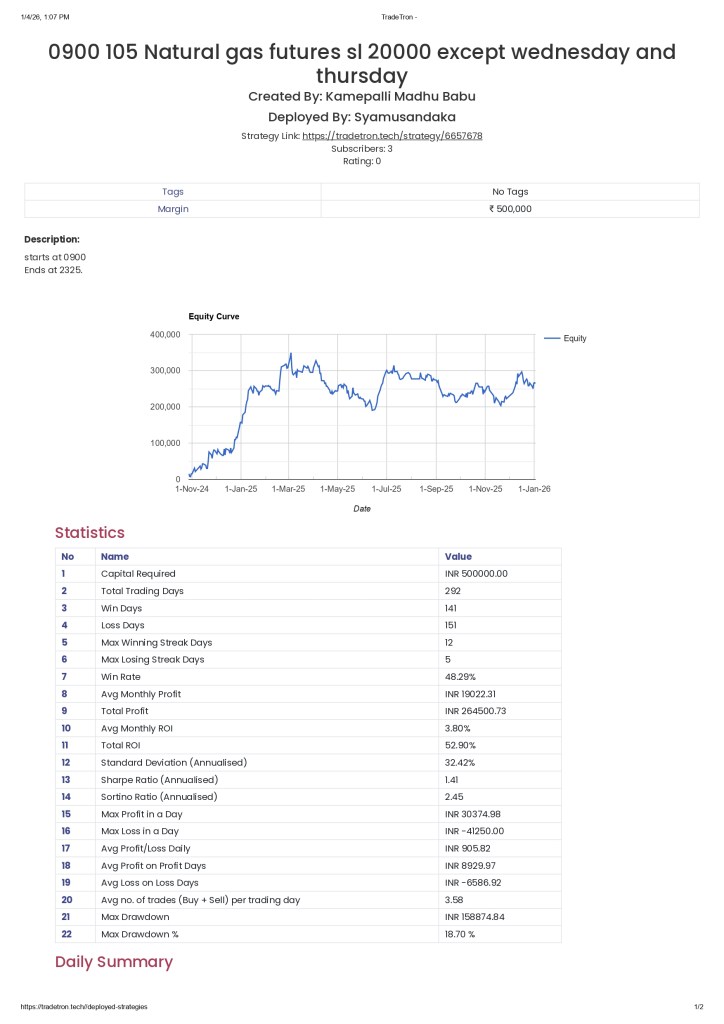
      Deployed on Tradetron (strategy link: tradetron.tech/strategy/6657678) with ₹5L capital, this 0900-105 Natural Gas futures setup (SL ₹20k, skips Wed/Thu) exploded out of the gate. From Nov 2024 to Jan 2025, it piled on massive gains:

      • Jan 2025: ₹1,00,375 (20.08% ROI)
      • Cumulative peak: Crossed ₹3 lakhs profit in the first few months.

       The equity curve looked like a rocket then by March 2025.

      The Brutal Reality: 9 Months of Drawdowns, No New Highs

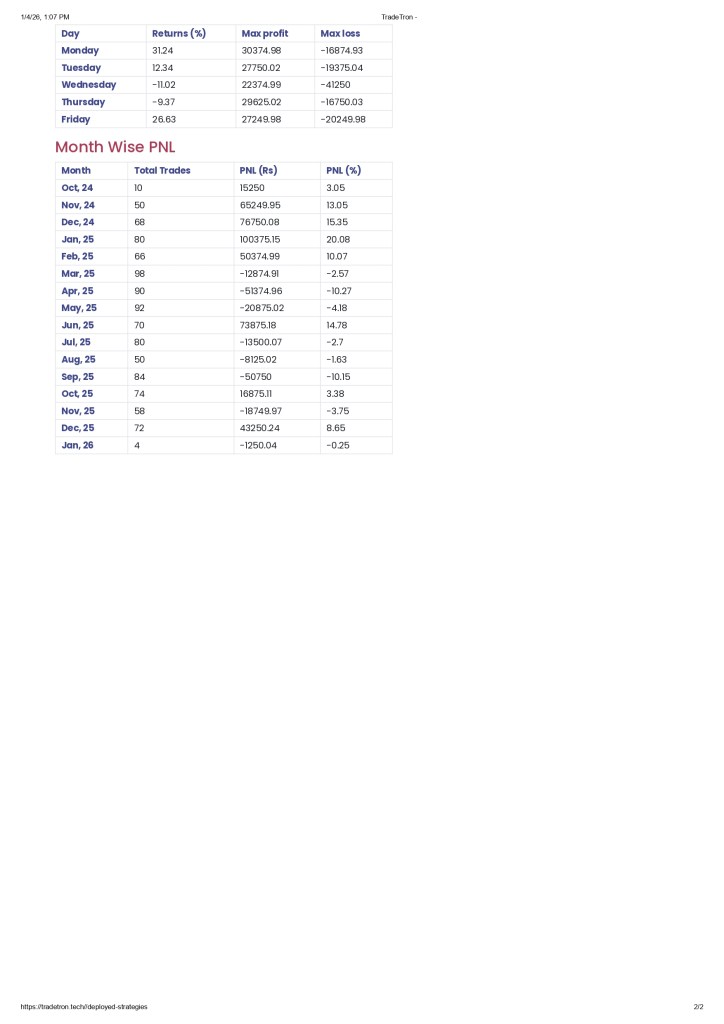
      Then… silence. For the next 9 months (Mar-Dec 2025), the strategy endured multiple drawdowns, with a brutal max DD of ₹1,58,875 (18.70%). Key offenders:

      MonthP&L (₹)ROI %
      Apr 25-51,375-10.27
      Sep 25-50,750-10.15
      Mar 25-12,875-2.57

      Despite total profit reaching ₹2,64,501 (52.90% ROI) and Sharpe 1.41, it never crossed the initial ₹3L high. Avg monthly profit: ₹19,022, but volatility (32.42% ann. std dev) ground it down. Max loss day: -₹41,250.

      Defining “Short-Term”: The Data Says 3-6 Months Is a Trap

      This isn’t theory—it’s empirical:

      • 3 months: Peak euphoria. Ignores regime shifts.
      • 6 months: Feels “long enough.” Still misses seasonal cycles, vol clusters.
      • 9 months: Exposed, but incomplete (one full commodity cycle?).

      The strategy’s 292 trading days (~14 months) reveal the truth: Early wins masked underlying fragility. Lesson: Minimum 12 months forward/live testing before scaling conviction.

      Why Long-Term Testing Separates Winners from Casualties

      Markets aren’t stationary. Natural Gas faces:

      • Seasonal demand swings (summer AC vs. winter heating).
      • Geopolitical shocks (Ukraine, Middle East).
      • Macro regimes (rate hikes crush commodities).

      Short tests catch none of this. A 1-year filter ensures:

      • Exposure to full cycles (bull/bear/flat).
      • Drawdown survival proof.
      • Statistical significance (enough trades for edge decay detection).

      The Iron Rule: 12 Months Minimum Before Live Scaling

      My rule, forged in drawdown fire:

      1. Backtest: 5+ years, multiple regimes.
      2. Forward test: 6 months minimum.
      3. Live test: 12 months minimum at small size before scaling. Watch for: peak recapture time, consecutive losing months, vol-adjusted returns.

      Final Verdict: Patience Is the Ultimate Edge

      “Never trust short-term.” Here, “short-term” means anything under 12 months. The market rewards those who wait for the full picture. Your strategy might peak at ₹3L in month 3… or grind sideways for 9 more. Test long, deploy slow, scale smart.

    • When a Winning Strategy Suddenly Gets Blocked

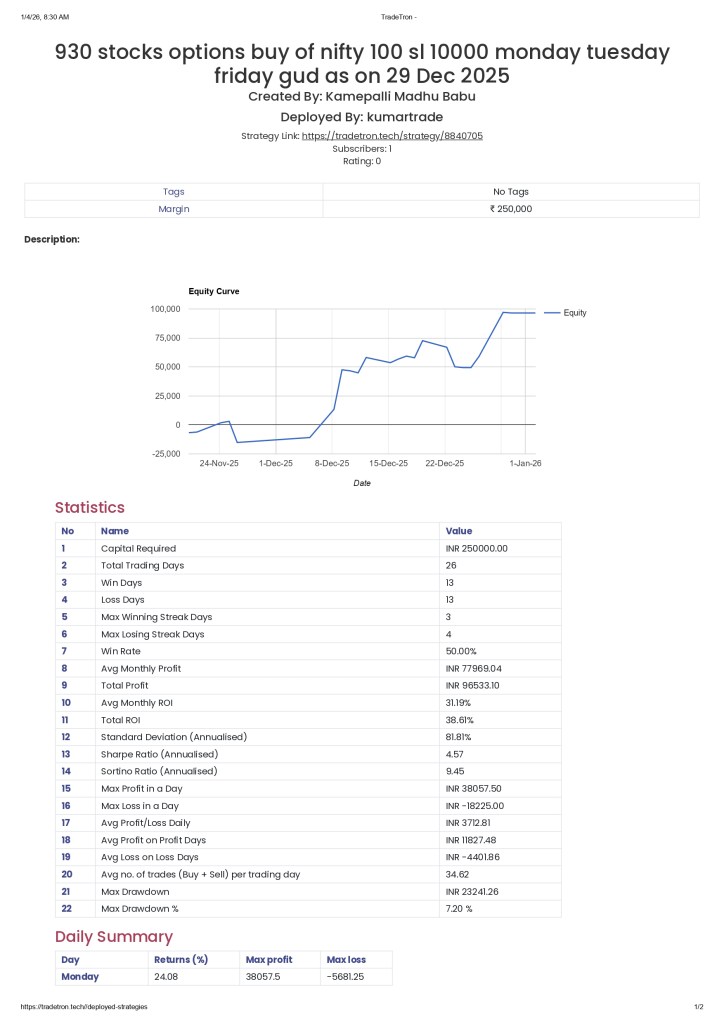
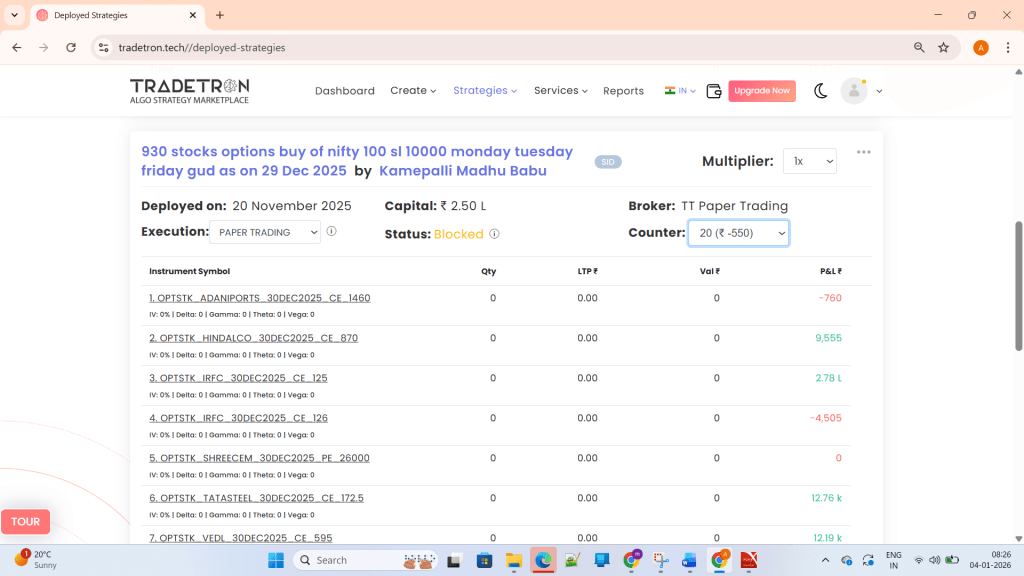
      The strategy in question was a 930‑stock options framework on NIFTY, designed to fire a large set of conditional orders with a ₹2.5L capital base in paper trading. The deployment ran smoothly for about 26 days, building a clean, continuous forward‑testing dataset and a healthy P&L trajectory.

      On monthly expiry day, however, the logic naturally became hyper‑active:

      • Multiple instruments met entry/exit conditions simultaneously.
      • The engine pushed a burst of orders in a short time window.
      • Tradetron’s internal risk/tech throttles classified this as “too many orders” and automatically shifted the strategy status to Blocked.

      From the platform’s perspective, this is a safety feature. From a systematic trader’s perspective, it is a data‑continuity nightmare.

      The Hidden Cost: Broken Equity Curves and Lost Context

      Once a strategy is in Blocked state, there is no graceful way to “resume” that same deployed instance. The standard workaround is:

      1. Delete the blocked deployment.
      2. Redeploy the same strategy afresh.

      The issue is not just inconvenience. The real damage is:

      • You lose the continuous forward‑testing record tied to that deployment.
      • Your equity curve is now split into before‑block and after‑block segments.
      • Any performance analytics (max DD, rolling returns, streaks) get skewed because they’re fragmented across instances instead of one continuous run.

      For traders who treat forward testing as seriously as live trading, this is unacceptable. The data is the strategy.

      Root Cause: Expiry Days and Order Bursts

      Why did this happen exactly on expiry? Because expiry days are structurally different:

      • Options decay accelerates; more conditions get triggered.
      • Volatility spikes intraday; stop‑losses and re‑entries fire more often.
      • Basket‑style or market‑wide strategies naturally generate order bursts.

      Platform‑level throttles don’t necessarily “understand” strategy intent—they only see order density, frequency, and technical constraints. When thresholds are crossed, the engine blocks the strategy to protect infra and possibly broker limits.

      So the failure was not in the trading logic, but in the interaction between your logic and the platform’s operational rules.

      The Simple, Powerful Fix: Pause on Monthly Expiry

      The elegant solution you arrived at is deceptively simple:

      Pause the strategy on the monthly expiry day to preserve the integrity of the deployment and its data.

      What this achieves:

      • Prevents expiry‑day burst from triggering a Blocked state.
      • Preserves the original deployment ID and full forward‑testing history.
      • Keeps your equity curve, drawdowns, and live testing stats continuous and analyzable.
      • Lets you treat expiry as a no‑trade risk‑day rather than a platform‑risk day.

      In practice, this turns expiry from a chaotic data‑breaking event into a deliberate “strategy rest day”.

      Turning Pain into a Robust Process

      This experience is more than a one‑off workaround; it is a template for building robust processes around systematic trading:

      • Platform‑aware design
        Don’t just design for market behaviour; design for how your platform behaves under stress conditions (rate limits, order caps, throttle logic).
      • Data‑first mindset
        Sometimes, skipping one high‑risk session (expiry) is worth it if it preserves a long, uninterrupted track record. Data continuity is an asset.
      • Pre‑planned off days
        Define in your playbook: days where the model could perform but structural or platform risks are too high—monthly expiries, certain event days, etc.
      • Operational rules as edge
        Most traders look for indicator edges; few optimize operational edges like when not to trade, how to avoid blocking, and how to preserve analytics.

      Conclusion: The Meta‑Edge

      The story of this blocked strategy is not about a “failure” but about an upgraded operating manual. The strategy logic worked. The platform did what it was designed to do. The gap was in anticipating that interaction on extreme days.

      By deciding to pause the strategy on monthly expiry instead of redeploying from scratch each time, I protected the most precious resource of any systematic trader: a clean, continuous, high‑quality data trail.

      In a world where everyone chases alpha in signals, sometimes the real meta‑edge is this: mastering the plumbing.

    • The Silver Futures Explosion: Fat Tails, Extremistan, and a Taleb-Style Trading Triumph

      Two weeks ago, I deployed a battle-tested Silver futures strategy on Tradetron—starting in the evening . It hummed along silently for months, delivering mild month-wise profits even in rough patches. But last week? Mind-blowing returns in forward testing lit up my dashboard, eyes glittering with that rare trader’s thrill. Deployed 2 lots live, and now it’s diversifying my evening portfolio alongside natural gas and crude oil. Classic Nassim Nicholas Taleb: fat tails in Extremistan, where black swans turn “silent modes” into explosive gains.

      From Dormancy to Dominance: The Stats Speak

      Over 166 trading days on ₹5,00,000 capital, this strategy clocked a total profit of ₹2,49,140—a stellar 49.83% ROI. With max streaks of 7 wins and just 4 losses. Average daily P&L hit ₹1,500.84, profits on win days averaged ₹6,311.62, losses capped at ₹-2,368.70.

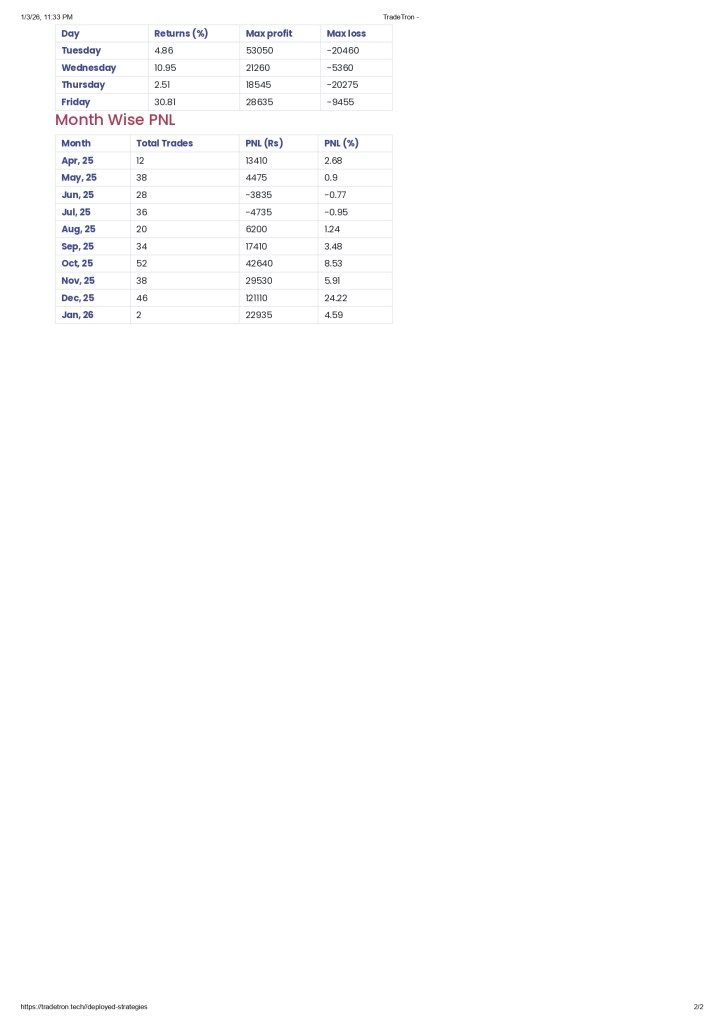
      Sharpe ratio annualized at 2.93, Sortino at 4.9—elite risk-adjusted returns despite 25.81% std dev. Max drawdown stayed tame at ₹42,605 , proving resilience. Friday’s were fireworks: 30.81% day returns, max single-day profit ₹53,050.

      MetricValue
      Total Profit₹2,49,140
      Total ROI49.83%
      Avg Monthly Profit₹31,517.71
      Avg Monthly ROI6.30%
      Max Drawdown₹42,605

      Monthly Breakdown: Silent to Sonic Boom

      Early months were steady: Apr ₹13,410 (2.68%), May ₹4,475 (0.9%). Dips in Jun/Jul (-0.77%, -0.95%) recovered fast. Explosion hit Oct: ₹42,640 (8.53%), Nov ₹29,530 (5.91%), Dec ₹1,21,110 (24.22%)—over 1/3rd of total profits. Jan 2026 (2 days): already ₹22,935 (4.59%). Avg trades/day: 1.84 buy/sell, low churn high impact.

      MonthTradesP&L (₹)ROI %
      Apr 251213,4102.68
      Oct 255242,6408.53
      Dec 25461,21,11024.22
      Jan 26222,9354.59

      Lessons from the Fat Tail: Why It Works Now

      Options flopped due to illiquidity? Futures shine with 500k margin efficiency. Portfolio diversification—silver evenings, others days—mitigates correlation risks. Taleb warns: Mediocristan averages bore; Extremistan’s tails deliver. This strategy slept through volatility, then erupted as silver hit all time highs.

      What’s Next: Riding the Tail

      No guarantees explosions persist, but data screams conviction: live 2 lots, scaling to MCX commodities suite. Fat tails favor the prepared—backtested resilience, forward-validated blasts. Traders, question: Ready for your Extremistan moment? Deploy smart, diversify bold.

      Strategy link: tradetron.tech/strategy/7632205 https://tradetron.tech/strategy/7632205

      Past performance no future promise. Trade at own risk.