Category: Uncategorized

  • Last Week’s P&L Was Great. The Real Win Was the Mindset. Profits should change the equity curve, not the trader’s character

    A Strong Week, But Not “Unlimited Joy”

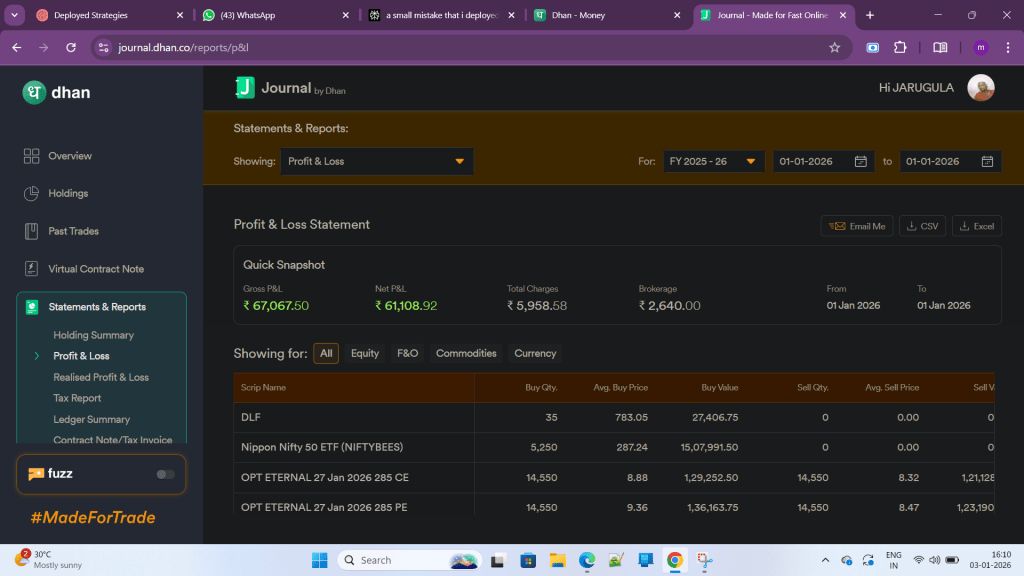
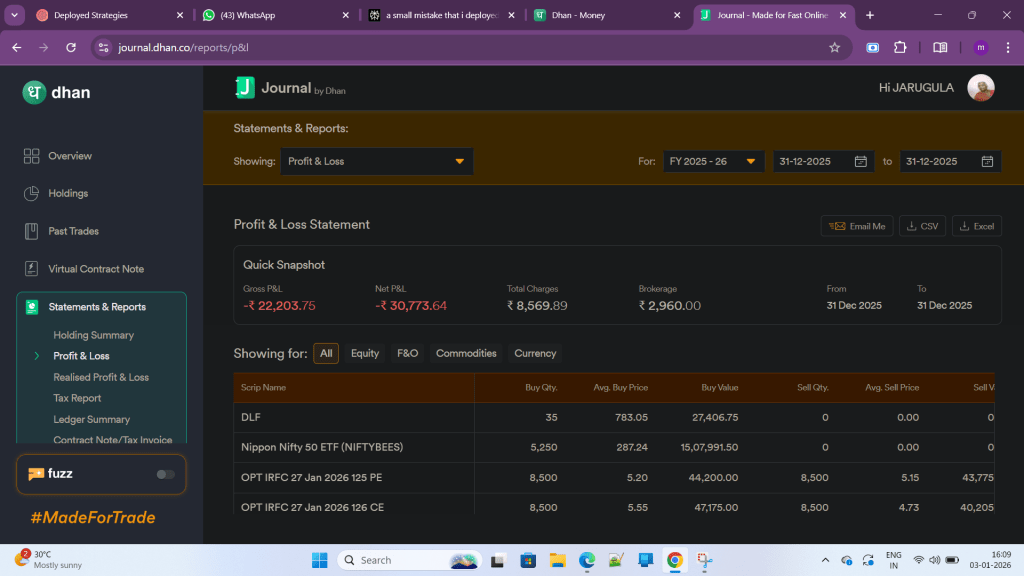
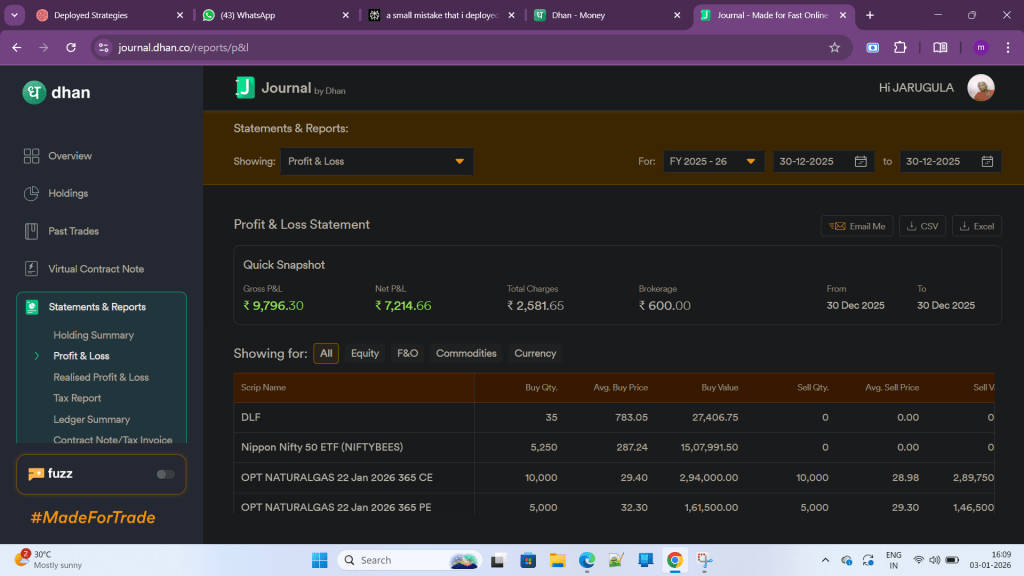
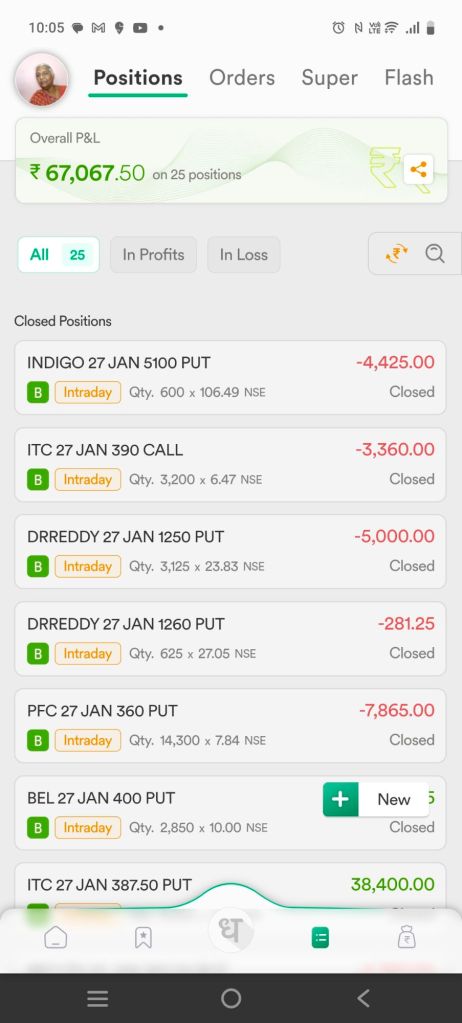
    Last week’s numbers were impressive: multiple days of solid green, with only Tuesday left on the table because fresh stock-option positions were not allowed on monthly expiry day due to physical settlement rules. On the first three days, only 3 lots per stock were deployed, and on the last two days, the exposure was scaled up to 6 lots, which naturally amplified the absolute profits.

    Yet this is not the time for unlimited celebration. It is just one phase in a normal market cycle where strong trending weeks and dull, directionless weeks keep rotating. Treating a good week as “normal business” rather than a jackpot keeps a trader grounded and protects against overconfidence.
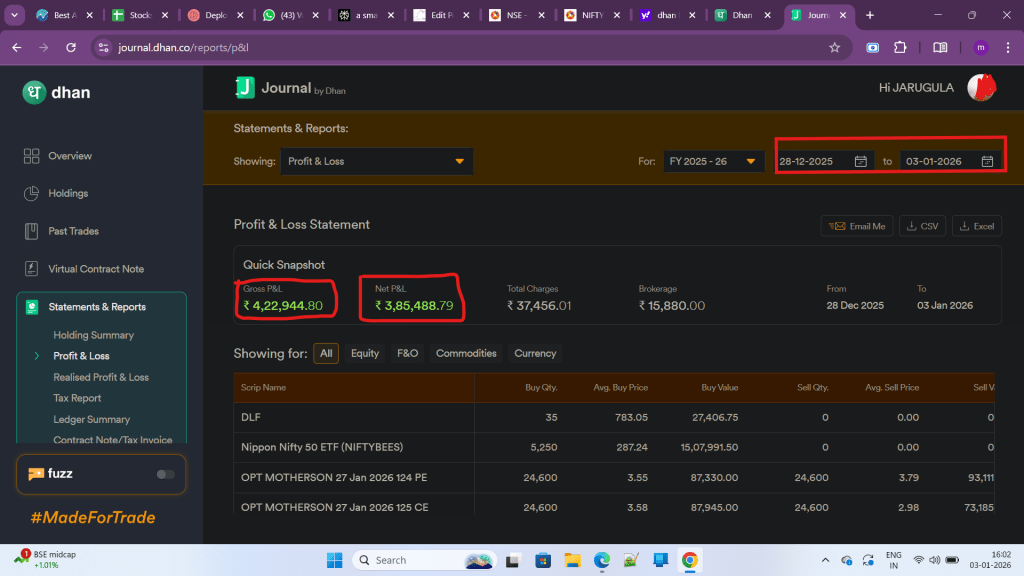
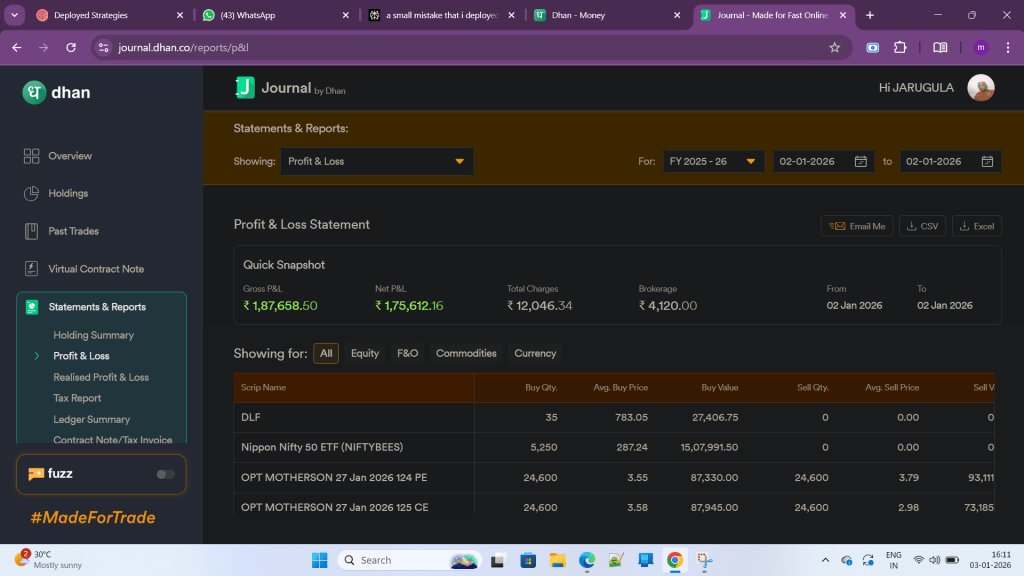
    The Tuesday That Got Away

    On Tuesday, the strategy signalled trades, and forward testing also showed strong potential performance, but the exchange’s restriction on fresh stock-option positions on monthly expiry day meant no new trades could be taken. The system did its job in forward testing (paper trading) well.

    This is an important psychological reminder. Some missed profits are not “mistakes” but structural constraints of the derivatives market, especially around physical-settlement expiries, and accepting that calmly is part of being a professional trader.

    Lots, Risk, And Normalizing Big Numbers

    Deploying 3 lots initially and then 6 lots later in the week was a deliberate way to scale risk as confidence in live behaviour increased. The higher lot size naturally made the last two days look spectacular on the statement, but in reality it was the same underlying edge with a slightly larger position.

    Professional trading means normalizing big P&L numbers emotionally. Profits should change the equity curve, not the trader’s character; the real metric is how faithfully the plan was executed at each lot size.

    Targets Versus Open-Ended Profits

    Last week also highlighted a deeper structural choice: comfort versus returns. Some strategies were run with fixed profit targets of 2,000–3,000, and these targets were hit reliably, giving psychological comfort and quick closure. However, those same targets also capped “bomblastic” moves where the market kept trending, and the system would have delivered far larger profits without a hard cap.

    In parallel, a set of target‑less strategies was running, allowing profits to trail and breathe, and these captured a much bigger portion of large moves, at the cost of enduring more open fluctuation. This side‑by‑side experience made one truth crystal clear: if the goal is long‑run capital growth, open‑ended exits with intelligent risk management beat small, comfortable caps.

    From Comfort To Conviction

    Trading literature has always emphasised letting winners run and avoiding premature profit booking, and many classic strategy authors advocate exits that maximise expectancy rather than emotional relief. But real conviction in that idea only comes when a trader sees, in personal forward testing, how much upside is left on the table by rigid profit targets.

    That is why the next phase is clear: target‑based variants will be kept only in forward testing or paper trading, while live capital will increasingly be allocated to robust, well-tested strategies without hard profit caps, supported by disciplined position sizing and risk controls. The mission now is simple: — to keep sieving through every statistic, every weekend, until the portfolio is dominated by strategies that may not feel the most comfortable in the moment but deliver superior returns over the long run.
  • Today’s market session will always be remembered as the day **Bosch** turned into the show‑stopper of my trading journal.

    The stock had already been on my momentum radar for a while. Bosch Ltd has the perfect ingredients for an intraday options play: 
    – Wide intraday ranges with strong directional bursts. 
    – Respectable option premiums that reward conviction. 
    – Clear technical structure that responds well to momentum filters.

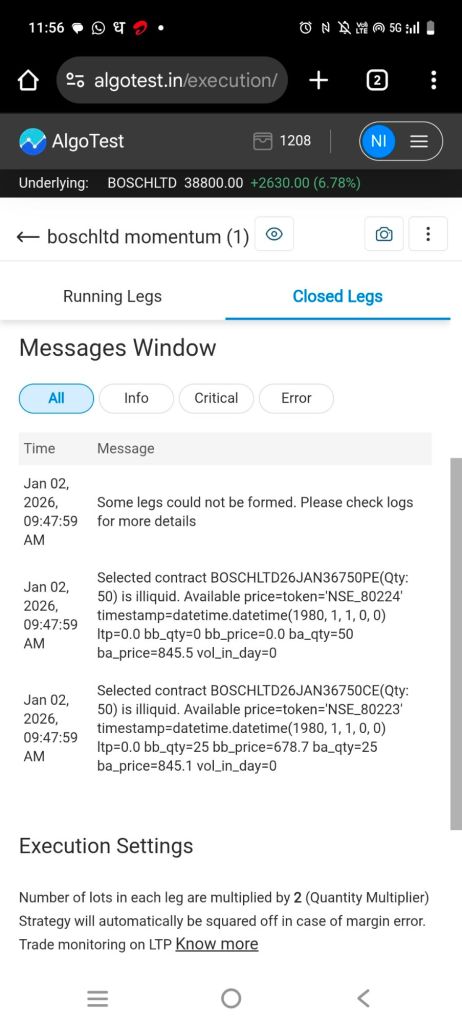
    Going into today’s session, my Bosch momentum strategy was ready on AlgoTest, configured to fire a 27 JAN 37000 CE breakout trade with proper position sizing and risk controls. The plan was simple: if price moved in line with my momentum rules, the system would enter automatically and manage the leg.

    The liquidity twist

    The day, however, decided to start with a twist. 

    In two of my accounts, the trade simply did not go through. The algo threw up a message that some legs could not be formed because of **liquidity issues** in the selected Bosch options contract. That is the harsh reality of trading stock options in India – even a rock‑solid setup can be blocked by thin depth on the bid–ask. 

    For a few minutes it looked like Bosch would remain just another “almost” trade in the log: a good idea, perfectly planned, but never executed.

    One fill, four lots

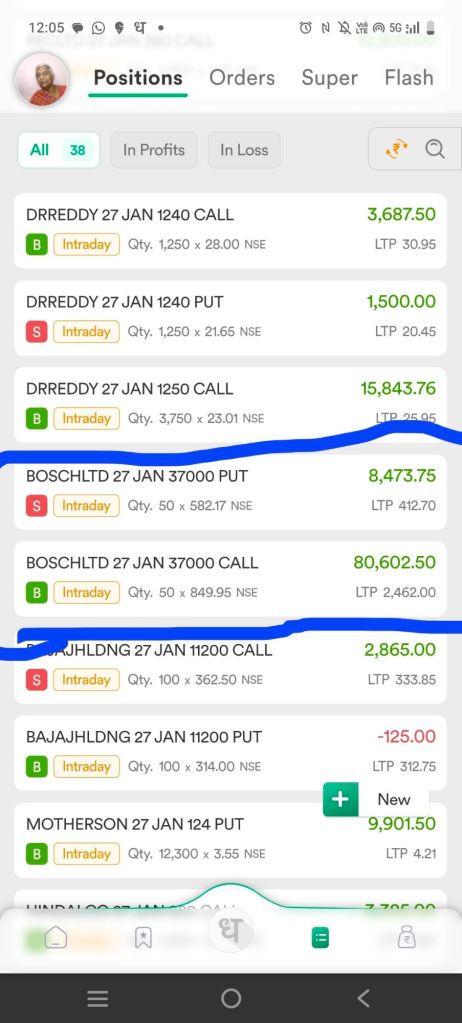
    Fortunately, one account slipped through the liquidity filter and actually got the desired fill. The 27 JAN 37000 CALL order was executed for 2 lots, while the other accounts stayed flat. 

    From there, Bosch did exactly what a momentum trader hopes for: 
    – Price sustained above key breakout levels instead of fizzling out. 
    – The call premium started expanding rapidly as the underlying kept pushing higher. 
    – Risk remained controlled, as the move was clean rather than whipsaw‑ridden.

    Watching the position from my broker’s app, the MTM kept climbing. At the time of writing this blog, the Bosch 27 JAN 37000 CE position in that single account is showing an unrealised profit of around ₹80,000 for 4 lots – a powerful reminder of how one well‑executed idea can pay for a long series of quiet days.

    Lessons from the Bosch trade

    Days like this are not just about the number on the P&L screen; they are about the lessons the market quietly offers:

    Liquidity is part of edge: A strategy is not complete until liquidity is factored in. Robust entries, exits, and risk parameters mean little if the instrument itself does not allow smooth execution. Today’s experience underlined why stock‑option strategies must always respect depth and slippage.

    – Missed trades can be blessings: It is easy to feel frustrated when a good setup does not get executed in all accounts. But risk is path‑dependent. The same liquidity issue that blocked entries today could just as easily protect capital on a bad day. In this case, the market was kind and allowed at least one account to participate.

    – Consistency beats prediction: There was nothing “magical” about today’s Bosch move. The trade came directly from a predefined momentum framework. No gut feeling, no last‑minute improvisation – just systematic execution. When the system and market conditions aligned, the result showed up in the P&L.

    Closing thoughts

    For now, Bosch Ltd wears the crown of “show man” of the day in my trading diary. The liquidity drama, the partial execution across accounts, and the strong follow‑through in price action together created a memorable session. 

    As this position continues to evolve, one thing is clear: in algorithmic and rule‑based trading, the job is to keep refining the process, respecting liquidity, and showing up every day – because it only takes one clean move like Bosch to make the entire effort feel worthwhile.

  • Title: A Small Oversight, A Big Lesson in Algo Trading

    Algorithmic trading is fascinating — it gives us the power to automate, optimize, and execute trades across platforms with precision. But with great automation comes the responsibility of double-checking even the smallest details.

    Recently, I encountered a situation that perfectly illustrates this. I had deployed one of my live trading strategies on Tradetron. Everything seemed fine — the logic was solid, the backtests were impressive, and I had allocated sufficient funds for execution. Yet, every single day, I was receiving error messages: “Insufficient balance.”

    At first glance, this was puzzling. After all, my Dhan account had more than enough funds. It took me a while before I realized what had gone wrong — I had accidentally deployed the strategy with Shoonya as the broker instead of Dhan. Shoonya, of course, had no balance. That simple mismatch was generating daily execution errors.

    It might sound like a small mistake, but it was a powerful reminder. In algo trading, even seemingly minor configuration errors can completely derail a system’s performance. The markets may forgive a missed entry, but automation does not forgive oversight.

    This experience reinforced one key lesson: always verify your broker mapping and fund allocation before deploying a live strategy. A quick checklist can prevent hours of unnecessary debugging and execution stress. Algo systems are only as reliable as the human discipline behind them.

    In short, this “silly” mistake made me ultra-aware of the importance of detail-oriented execution. Automation magnifies efficiency — but it also magnifies human errors. The more advanced our trading setups become, the more humble and careful we must stay as traders.

  • a classic Taleb-style fat-tail day where almost everything bleeds, two stocks pay, and one of them (ITC) delivers a barbell payday. A New Year That Started With A Tail


    The first trading day of the year did not come dressed as a gentle mean-reversion day.
    It came as one of those rare, asymmetric sessions where markets remind you that returns do not follow neat textbook curves but thick, messy fat tails instead.

    On paper, the setup was simple: eight stocks on the radar, six of them ending in the red for the P&L, and only two—DMart and ITC—showing profit. That distribution alone says a lot about how real trading works: most bets grind, a few shine, and a tiny minority pay for the whole day, week, sometimes year.


    ITC: When A Defensive Name Misbehaves

    ITC is supposed to be the calm, “defensive” counter in most portfolios, the stable leg people hold for comfort.
    Yet on this particular day, ITC behaved like a high-beta midcap and tanked around 10%, offering the kind of sharp move that is statistically “rare” but empirically far more frequent in markets with fat-tailed return distributions.

    The trade was elegantly one-sided in spirit:

    • Buying puts to stay long convexity on the downside.
    • Selling calls to monetize elevated volatility and help finance the bearish view.

    Capturing nearly 80% of that 10% slide meant the structure was aligned almost perfectly with the path price eventually took. The stock did the violent part; the options  translated that violence into realized P&L.


    Taleb, Fat Tails, And Barbell Profits

    Nassim Nicholas Taleb’s work is built around a simple but brutal observation: financial markets live closer to “Extremistan” than “Mediocristan”; extreme moves happen more often than Gaussian models admit.
    In fat-tailed worlds, the rare event is not an outlier—it is the main character that pays the bills.

    The “barbell” Taleb proposes is conceptually binary:

    • One side: ultra-safe, low-risk exposures that keep you away from ruin.
    • Other side: highly convex, speculative bets that lose small most of the time but make disproportionate gains when tails show up.

    On a day like this, the ITC book is the right-side barbell in action: a convex payoff profile positioned for a tail move. The rest of the watchlist, with its small scratches and losses, is the cost of staying in the game long enough to meet that one payoff.


    TorntPharma: A Quiet Reminder About Liquidity

    Not everything that can theoretically be traded should be traded aggressively.
    TorntPharma offered a live reminder: thin liquidity, wider spreads, and the ever-present risk that getting in is easy but getting out is a completely different story.

    Illiquidity transforms seemingly attractive option structures into fragile ones.
    Slippage and partial fills can eat into the exact convexity that fat-tail thinking is trying to harness. Escaping the day without TorntPharma impacting the book was another, quieter form of profit: the gain of avoiding unnecessary fragility.


    The Essence Of A Fat-Tail Trading Day

    Looked at through Taleb’s lens, this day is not “lucky” noise; it is the structural logic of a barbell philosophy playing out in miniature.

    • Many trades existed, but few mattered.
    • Among the few that mattered, one trade—ITC—dominated.
    • The payoff came not from predicting the exact magnitude of the fall, but from standing positioned with convexity when the fall happened.

    This is what fat-tail profits look like in practice: a handful of outsized winners paying for a sea of mediocrity, wrapped inside a framework that respects risk, avoids ruin, and stays humble before uncertainty—very much in the spirit of Taleb, and a fitting way to open a new trading year.

  • 14 Consecutive Days of ₹2,000 Daily Profits: The Unbreakable Stock Options Strategy on Tradetron

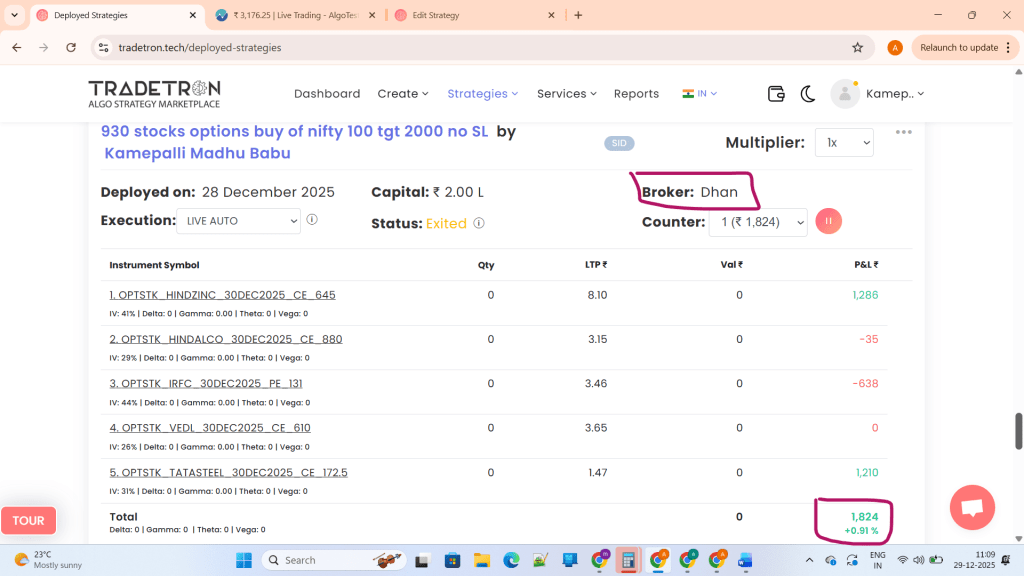
    This 14‑session streak with consistent ₹2,000 targets hit in live trading on stock options (9:40 entry to 14:59 exit) marks a rare achievement in intraday algo trading.

    How This Strategy Delivers

    This intraday system targets Nifty stock options, entering right time when momentum builds and exiting by target hit or by 2:59 PM to avoid late volatility. It has powered through 14 straight sessions in live deployment with Dhan broker on Tradetron, hitting the ₹2,000 target each day on just ₹2 lakhs capital.
    Recent refinements—like option movement in entry conditions and repair-continuous logic—resolved data feed issues, making it even more robust for real markets.
    Deployed counters show steady execution across varying market conditions, proving its edge in both trending (uptrend and downtrend) and range-bound days.

    Why 14 Wins in a Row?

    Backed by 5+ years of algo refinement, it focuses on data-validated rules: no overall SL yet (testing variants live), but leg-wise stops keep drawdowns minimal.
    Diversification across stocks prevents single-asset failures, aligning with proven intraday option baskets.

    Live Results at a Glance

    MetricValueNotes
    Sessions14 consecutiveAll targets hit ₹2,000/day
    Capital₹2 lakhsLow entry barrier
    IntradayIntradayIntraday
    BrokerDhan via TradetronReliable execution

    Data-Driven Next Steps

    Run parallel variants (₹4k/₹6k/₹8k overall SL vs none) for the next 30 days to pick the winner based on max drawdown and win rate.
    Scale gradually: add counters only after confirming edge holds through a losing phase; and don’t forget diversification.
    Monitor Tradetron dashboard for slippage and repairs—my empirical approach ensures only data decides deployment.

    Important Disclaimer

    Past performance, including this 14-day streak, does not guarantee future results. Options trading involves substantial risk of capital loss due to volatility, slippage, broker issues, or events like expiry theta decay and geopolitical shocks. No overall portfolio SL means potential for larger drawdowns; always use risk capital only (1-2% per trade max), test in paper mode first, and consult a SEBI-registered advisor. Not investment advice—trade at your own risk.

  • Tradetron’s Recurring “Price Zero” Error: My plans to Switch to AlgoTest

    Tradetron strategies often halt due to “instrument seems illiquid, price is zero” errors, like with Torntpharma, forcing manual intervention to resume trading. This issue stops all further condition checks for the day until users mark it “completed manually,” disrupting automated flows. The same strategies run flawlessly on AlgoTest with the identical broker, highlighting platform differences.​

    Error Details

    Notification logs show messages like “Torntpharma price is zero, seems illiquid,” appearing in both live and paper trading. Affected strategies display zero execution counts and error status on the dashboard, with capital locked at ₹200. Users must navigate to logs, manage the error, and manually complete it to proceed, a repetitive fix for multi-stock lists.​

    Why It Halts Trading

    Tradetron stops the entire strategy on any illiquid instrument detection, even if others are viable, unlike configurable skips in some platforms. Low liquidity in options or strikes triggers zero-price reads from broker data, common in equity options. This exposes traders to missed opportunities, as no further entries occur until reset.​

    Manual Workaround Steps

    • Access deployed strategies dashboard and click the three dots for the errored one.​
    • Select “Notification Log,” identify the zero-price entry, then “Manage Error.”​
    • Choose “Completed Manually,” ​
      This restores checking but requires daily monitoring, unsuitable for hands-off algo trading.youtube​

    AlgoTest Superiority

    AlgoTest handles the same Torntpharma strategy without errors, offering free backtesting, high customization, and no-coding strategy building. It provides detailed performance reports, real-time support, and multi-broker integration (35+), running smoothly where Tradetron falters. Users report easier interfaces and precise execution, ideal for commodities and options .

    Platform Comparison

    FeatureTradetron algotestAlgoTest algotest
    Error HandlingHalts on illiquid; manual fixContinues seamlessly
    BacktestingPaid plans required25 free weekly
    CustomizationHigh, some codingVery high, no-code builder
    SupportAdequateHighly responsive, real-time
    Cost StructureSubscription starts paidCredit-based, flexible
    User InterfaceTricky for beginnersIntuitive, all-in-one toolkit

    My Decision Ahead

    Raised the issue with Tradetron support; a fix would retain value for its automation. Without resolution, full migration to AlgoTest makes sense for reliability in live trading. Traders facing similar disruptions should test strategies cross-platform before scaling.

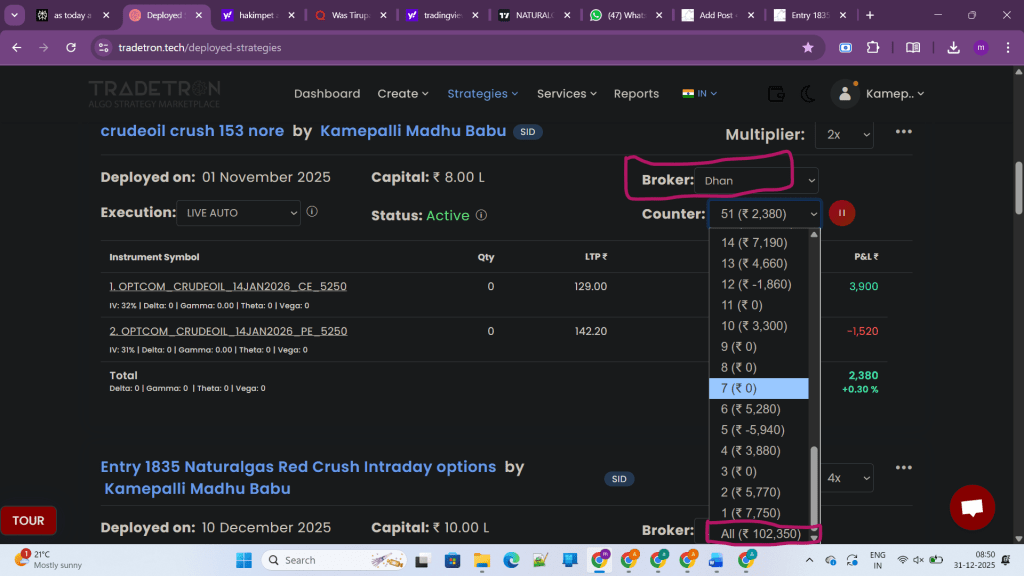
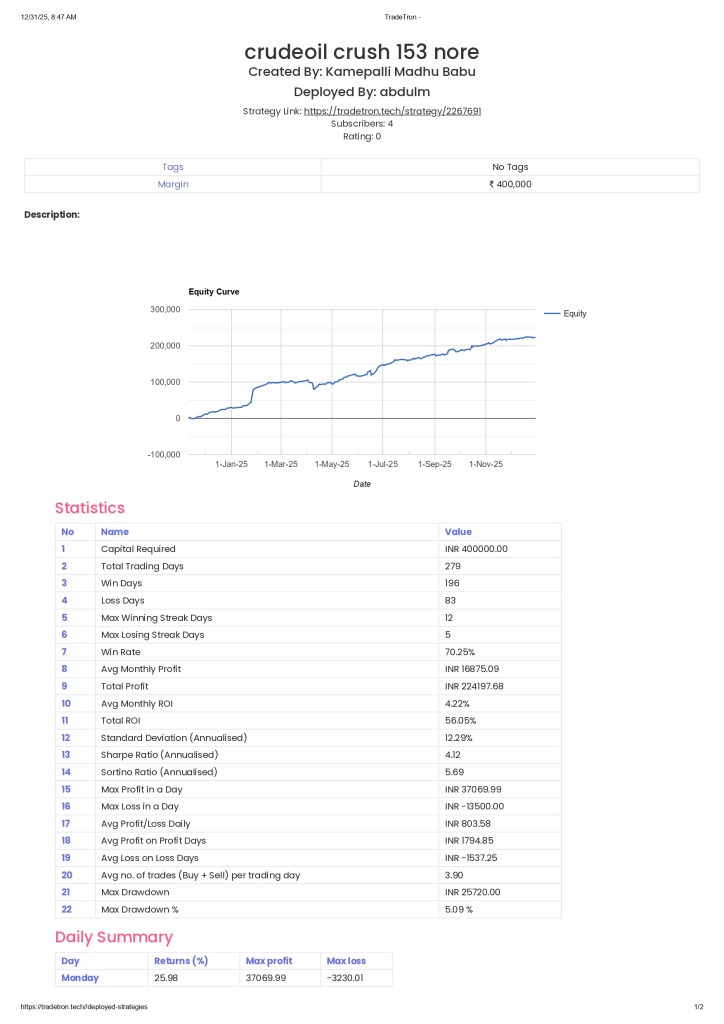
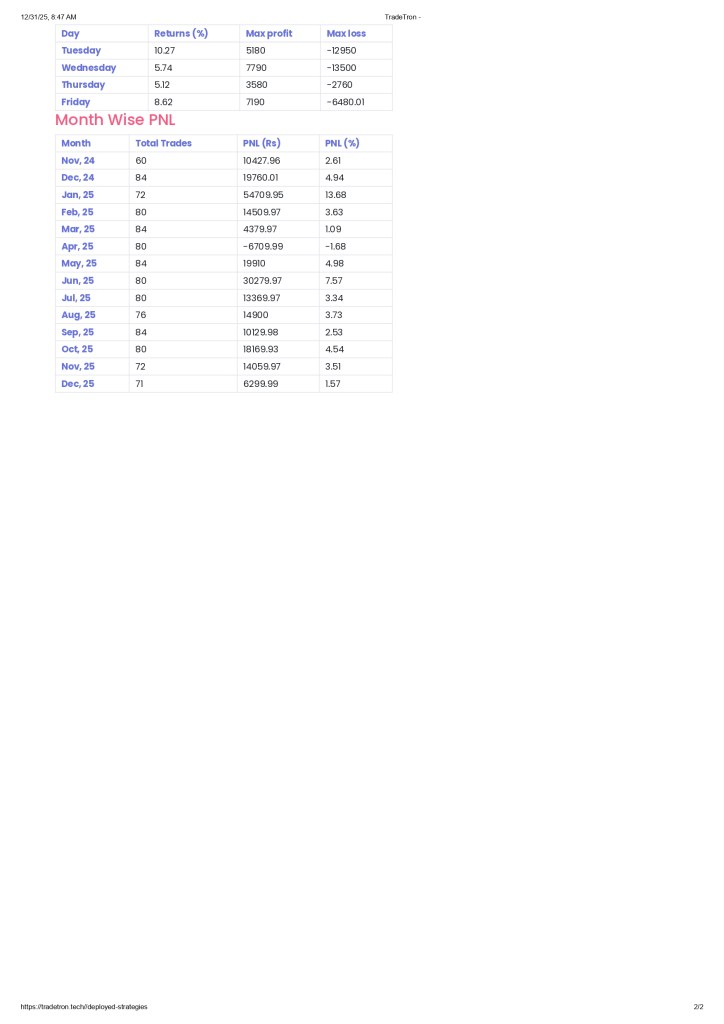
  • Crude Crush 1530 stands as the most reliable strategy in live deployment over the past year on Tradetron with Dhan broker, crossing ₹1 lakh in profits as of December 31, 2025. This intraday crude oil options system targets MCX evening volatility, delivering consistent execution in real-market conditions.

    Proven Live Performance

    Deployed continuously for 12 months, Crude Crush 1530 has generated over ₹2,27,000 in verified profits, showcasing resilience across crude oil’s volatile swings. The dashboard reveals multiple successful legs with positive P&L on key dates like November and December 2025, confirming real-time profitability beyond paper trading(Forward Testing). Evening session focus aligns with peak MCX liquidity from 3:30 PM to 11:30 PM, where global crude moves create premium opportunities.

    Strategy Mechanics

    This intraday options approach enters crude oil positions post-1530 IST, capitalizing on US session overlap for momentum and mean-reversion setups. Automated via Tradetron-Dhan integration, it handles multi-leg executions (e.g., 2-4 lots) with Dhan’s multiplier. Risk controls include time-based exits before session close, avoiding overnight gaps from EIA reports or OPEC news.

    Edge in Crude Oil Trading

    Crude oil’s high volatility suits this system’s premium capture, outperforming in range-bound and breakout regimes common to MCX evenings. Live stats show strong win rates on deployed legs, with Dhan enabling efficient collateral use.

    Deployment Advantages

    Full Tradetron automation removes emotional bias, with Dhan’s free APIs handling live execution seamlessly for MCX options. Strategy suits working professionals targeting evening crude moves, backed by one-year empirical data over diverse market conditions.

    Mandatory Disclaimer and Risks

    Past performance does not guarantee future results. This strategy faced drawdowns and will encounter losing periods; crude oil volatility can spike unexpectedly from geopolitical events, inventory data, or USDINR shifts. Trading derivatives involves substantial risk of capital loss; slippage, broker issues, and margin calls can erode profits. Not investment advice—consult a SEBI-registered advisor, trade only risk capital, and review all risk disclosures before deployment.

    https://tradetron.tech/strategy/2267691

  • Entry 1835 Naturalgas Red Crush Intraday Options

    Entry 1835 Naturalgas Red Crush Intraday Options has delivered more than 60% win rate and over 5% monthly returns in the evening session since May, making it a compelling MCX options strategy for systematic traders. Yet every trader must remember that these outcomes are historical; past returns do not guarantee future performance, and capital is always at risk.

    Strategy Concept and Market Focus

    This strategy trades natural gas options on MCX, targeting the evening session when liquidity and volatility typically rise. Natural gas’s intraday swings create opportunity for premium capture and quick risk adjustments.

    Win Ratio and Return Profile

    Backtests and live deployment data since May show a win ratio comfortably above 60%, giving traders a statistical edge over pure directional guessing. On a portfolio basis, the strategy has produced more than 5% average monthly returns, which is strong for a collateral-efficient intraday system. However, these numbers are period-specific and may compress sharply during adverse time of this strategy.

    Intraday Design and Risk Controls

    Positions are initiated only in the evening segment, avoiding daytime noise and targeting well-defined volatility pockets. The intraday framework ensures positions are squared off before the session ends, limiting overnight gap risk from global commodities or macro news. Position sizing is calibrated to an indicative capital requirement of about ₹2.5 lakh, with risk managed through pre-defined exits and time-based closures.

    Automation, Fees, and Accessibility

    The strategy is available on Tradetron, allowing full automation with connected brokers and removing execution emotion from the decision loop. Deployment is subscription-based, with a transparent monthly fee structure so traders can factor cost into expected net returns. Cloud execution, reporting, and broker integrations make it accessible even for traders who do not code.[2]

    Key Risks and Mandatory Disclaimer

    Despite strong recent performance, this strategy can and will face losing streaks, drawdowns, and regime shifts in natural gas volatility. Slippage, broker/API failures, and sudden margin changes can also materially affect actual results versus Paper Trading (forward testing). This article is for educational purposes only and is not investment advice; derivatives trading involves substantial risk of loss, and past performance does not guarantee future returns under any circumstances.

    https://tradetron.tech/strategy/7800541

  • Dhan Vs Zerodha

    Dhan’s pledged collateral unavailability strikes again on critical trading days, frustrating algo traders despite a year of otherwise smooth operations. This marks the third such incident in 12 months, pushing consideration of a Zerodha switch despite the hassle of account opening and holdings transfer. New traders get a strong warning: skip Dhan and start with Zerodha for dependable margin access.

    Recurring Pledge Glitches

    Collateral from pledged holdings shows as available but fails to fund F&O trades on sporadic days, capping positions like today’s Nifty options deployment. SEBI pledge rules require explicit activation, yet Dhan’s system lags or rejects during volatility, unlike consistent peers. One year in, three disruptions signal unreliability for expiry-heavy algos.

    Migration Effort vs Reward

    Opening Zerodha demands selling holdings, CDSL transfers (3-7 days), and Tradetron API reconfiguration—workload delays full switch. Zerodha’s ₹300 AMC and ₹2,000 API fee contrast Dhan’s free tier, but superior margin stability justifies it for pros.  

    Broker Verdict for Newbies

    AspectDhan PitfallsZerodha Strengths
    Collateral UseIntermittent blocksReliable across segments
    Algo CostsFree APIs₹2k/month fee
    Reliability3 glitches/yearProven for high-volume
    Transfer EaseOff-market chargesFree closure option

    Zerodha wins for margin-critical trading; Dhan suits low-stakes only.

    Trader Advisory

    Open account in Zerodha rather than with Dhan.

  • Tradetron Strategy Update: Repairs, Entries, and Target Hits

    Yesterday’s two key updates to the intraday options strategy—one enhancing the repair continuous function and the other shifting entry conditions to option movement—yielded mixed results in live trading. The repair continuous mechanism operated flawlessly, handling multiple entries with precise leg-specific adjustments using Traded Instrument keywords. However, the option-based entry failed to trigger trades despite market conditions aligning, forcing a revert to reliable underlying price triggers.

    Performance Wins

    Both strategies delivered: 930-level hit 2000 target, and 955-level reached 3000 as tracked over recent sessions. These hits reinforce the 10+ day streak.