Tag: artificial-intelligence

  • When Execution Teaches Hard Lessons: A Trader’s Honest Reflection and a Stronger Comeback

    Last week was one of those weeks that every serious algorithmic trader inevitably faces—not because the strategy failed, but because execution exposed weak links in the process.

    I believe it’s important to share not only success stories, but also the mistakes, learnings, and corrections that shape long-term consistency. This blog is exactly that.


    Issue 1: Combined Buy & Sell Legs — A Costly RMS Lesson

    In one of my strategies, I was deploying buy and sell legs together for a stock. On paper, the logic was sound.
    But in live execution, a critical issue surfaced:

    • One leg got executed successfully
    • The other leg got rejected due to RMS (Risk Management System) constraints
    • The strategy moved into an error state
    • As a result:
      • Stop-losses were not carried
      • Targets were not placed
      • The open position became unmanaged

    📉 Outcome:
    A loss of nearly ₹20,000 in a single stock—not due to strategy logic, but due to execution dependency.

    ✅ The Fix Implemented

    I immediately redesigned the execution logic:

    • Buy legs and sell legs are now deployed separately
    • Each leg is independently monitored
    • Even if RMS rejects one side, the other leg remains protected
    • Stop-loss and target placement is now non-negotiable

    This change has eliminated single-point execution failure.


    Issue 2: Human Error — Deploying 4 Stocks Instead of 8

    On another trading day, the strategy performed exceptionally well.
    However, due to an execution oversight:

    • I deployed the strategy on only 4 stocks instead of the usual 8
    • The market rewarded the setup perfectly

    📈 Missed Opportunity:
    Approximately ₹30,000 in unrealized profit, purely because of incomplete deployment.

    ✅ The Fix Implemented

    To prevent this from ever repeating:

    • I now religiously cross-check the number of stocks deployed every single day
    • A fixed pre-market and post-deployment checklist is followed
    • No strategy is considered “live” unless all intended stocks are confirmed

    Process discipline is now as important as strategy logic.


    What These Experiences Reinforced

    These incidents didn’t weaken the system—they strengthened it.

    They reinforced three core truths of professional algo trading:

    1. Execution matters as much as strategy
    2. Small process gaps can cause large financial impact
    3. Immediate correction is the hallmark of a serious trader

    Instead of ignoring these mistakes, I embraced them, fixed them, and upgraded the system.


    Looking Ahead: Focused, Corrected, and Ready

    With:

    • Separated buy/sell leg execution
    • RMS-safe logic
    • Strict deployment verification
    • Daily discipline in execution checks

    I step into the coming week with confidence, clarity, and caution—the right combination for sustainable returns.

    Markets will do what they always do.
    What matters is that my systems are now better prepared.

    📊 Looking ahead to next week for strong, controlled returns.
    Let’s see what the market brings—this time with sharper execution and stronger safeguards.


    Final Thought

    Losses teach.
    Missed profits remind.
    Corrections build consistency.

    This is not just trading.
    This is evolution.

    Madhu Babu

    When Execution Teaches Hard Lessons: A Trader’s Honest Reflection and a Stronger Comeback

    Last week was one of those weeks that every serious algorithmic trader inevitably faces—not because the strategy failed, but because execution exposed weak links in the process.

    I believe it’s important to share not only success stories, but also the mistakes, learnings, and corrections that shape long-term consistency. This blog is exactly that.


    Issue 1: Combined Buy & Sell Legs — A Costly RMS Lesson

    In one of my strategies, I was deploying buy and sell legs together for a stock. On paper, the logic was sound.
    But in live execution, a critical issue surfaced:

    • One leg got executed successfully
    • The other leg got rejected due to RMS (Risk Management System) constraints
    • The strategy moved into an error state
    • As a result:
      • Stop-losses were not carried
      • Targets were not placed
      • The open position became unmanaged

    📉 Outcome:
    A loss of nearly ₹20,000 in a single stock—not due to strategy logic, but due to execution dependency.

    ✅ The Fix Implemented

    I immediately redesigned the execution logic:

    • Buy legs and sell legs are now deployed separately
    • Each leg is independently monitored
    • Even if RMS rejects one side, the other leg remains protected
    • Stop-loss and target placement is now non-negotiable

    This change has eliminated single-point execution failure.


    Issue 2: Human Error — Deploying 4 Stocks Instead of 8

    On another trading day, the strategy performed exceptionally well.
    However, due to an execution oversight:

    • I deployed the strategy on only 4 stocks instead of the usual 8
    • The market rewarded the setup perfectly

    📈 Missed Opportunity:
    Approximately ₹30,000 in unrealized profit, purely because of incomplete deployment.

    ✅ The Fix Implemented

    To prevent this from ever repeating:

    • I now religiously cross-check the number of stocks deployed every single day
    • A fixed pre-market and post-deployment checklist is followed
    • No strategy is considered “live” unless all intended stocks are confirmed

    Process discipline is now as important as strategy logic.


    What These Experiences Reinforced

    These incidents didn’t weaken the system—they strengthened it.

    They reinforced three core truths of professional algo trading:

    1. Execution matters as much as strategy
    2. Small process gaps can cause large financial impact
    3. Immediate correction is the hallmark of a serious trader

    Instead of ignoring these mistakes, I embraced them, fixed them, and upgraded the system.


    Looking Ahead: Focused, Corrected, and Ready

    With:

    • Separated buy/sell leg execution
    • RMS-safe logic
    • Strict deployment verification
    • Daily discipline in execution checks

    I step into the coming week with confidence, clarity, and caution—the right combination for sustainable returns.

    Markets will do what they always do.
    What matters is that my systems are now better prepared.

    📊 Looking ahead to next week for strong, controlled returns.
    Let’s see what the market brings—this time with sharper execution and stronger safeguards.


    Final Thought

    Losses teach.
    Missed profits remind.
    Corrections build consistency.

    This is not just trading.
    This is evolution.

    Madhu Babu

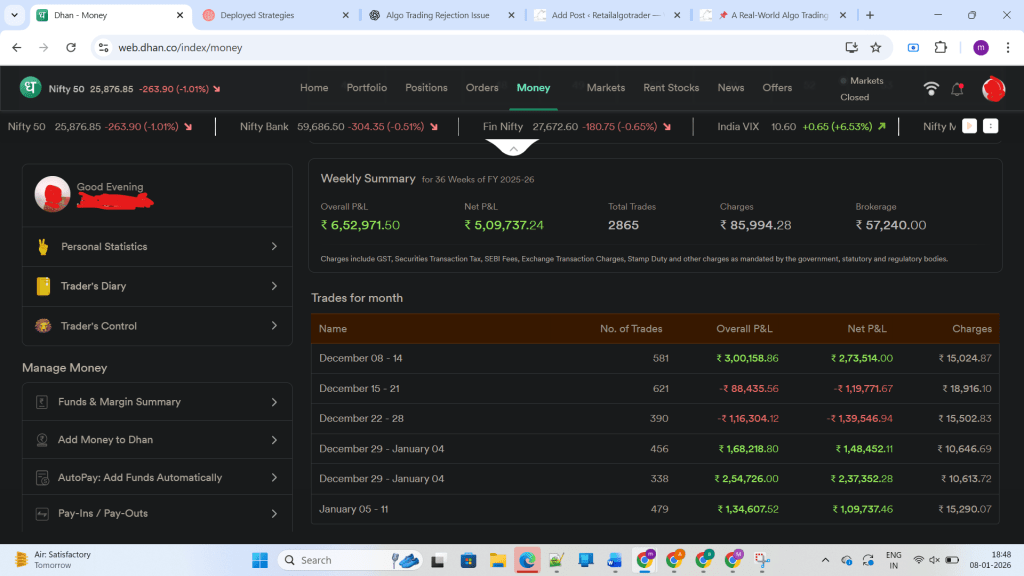
  • 📊 Six Weeks, ₹5 Lakhs Net P&L — And the Truth Behind the Numbers

    Dear Subscribers,

    I want to share a clear, unfiltered view of what has happened in my trading over the last six weeks—not just the results, but the real process behind them.

    📈 The Headline Number

    • Net P&L (last 6 weeks): ~₹5,00,000
    • Capital deployed: ~₹35,00,000

    These results did not come in a straight line.


    🔻 Two Consecutive Losing Weeks — Yes, That Happened

    Out of the last six weeks:

    • Two weeks were consecutive losing weeks
    • Losses were not only market-driven
    • A significant portion came from execution and system-level issues

    This is important to understand because real algo trading is not just about strategy logic—it’s also about execution reliability.


    ⚙️ The Problems I Faced (Openly Explained)

    Over these weeks, I encountered multiple challenges:

    1️⃣ Execution Errors (Platform & Coding Level)

    • Orders not firing as expected
    • Partial deployment (e.g., 4 stocks instead of intended 8)

    2️⃣ Repair Logic Limitations (Earlier)

    • Initially, only one repair entry was coded
    • Strategy required continuous repair, not a single repair
    • This was fixed by implementing a continuous repair function

    3️⃣ Market Data Issues

    • Stock prices not updating continuously
    • This affected targets and stop-loss execution
    • I attempted to shift logic to option-price-based execution
    • That approach could not be fully implemented due to platform constraints (Tradetron)
    • but Algotest platform solved the above issue.

    4️⃣ Manual Intervention Became Necessary

    • Whenever an error occurred, I manually repaired and completed the trade
    • Strategy logic continued, but…
    • This required continuous monitoring, which is not ideal but became necessary during system evolution

    🧩 Platform Reality: Why I Use Both Tradetron & Algotest

    • Many of the above issues are significantly reduced on Algotest
    • Some issues still exist on Tradetron
    • As of now, I am running strategies on both platforms
    • No emotional decisions, no sudden shifts—only measured evaluation

    This is real trading, not marketing trading.


    🧠 A Very Important Clarification

    Let me be absolutely clear:

    I am NOT saying
    “There will be no more losing weeks.”

    That would be dishonest.

    What I am saying is:

    • The specific problems I faced
    • The solutions I implemented
    • The lessons I learned

    Losing weeks—and sometimes even losing months—are normal and unavoidable in systematic trading.

    They are not a failure of strategy or discipline.
    They are part of the strategy lifecycle.


    📚 Continuous Learning Is Non-Negotiable

    I still consider myself a continuous learner of the markets.

    Every issue I faced:

    • Made the system stronger
    • Improved risk awareness
    • Enhanced execution discipline
    • Increased transparency with subscribers

    Markets evolve.
    Platforms evolve.
    Strategies must evolve.

    And so must the trader.


    🤝 Why I Share All This With You

    Because you are not just following signals—you are:

    • Participating in a real trading journey
    • Experiencing real drawdowns
    • Benefiting from real system improvements

    There are no perfect equity curves.
    There are only honest traders who adapt.


    🧘 Final Thoughts

    Profits bring confidence.
    Losses bring clarity.
    Survival brings mastery.

    We will have winning weeks.
    We will have losing weeks.
    What matters is process, risk control, and transparency.

    Thank you for trusting the journey—not just the results.

    Madhu Babu
    Algo Trader | Strategy Developer | Continuous Student of Markets

  • When a Winning Strategy Suddenly Gets Blocked

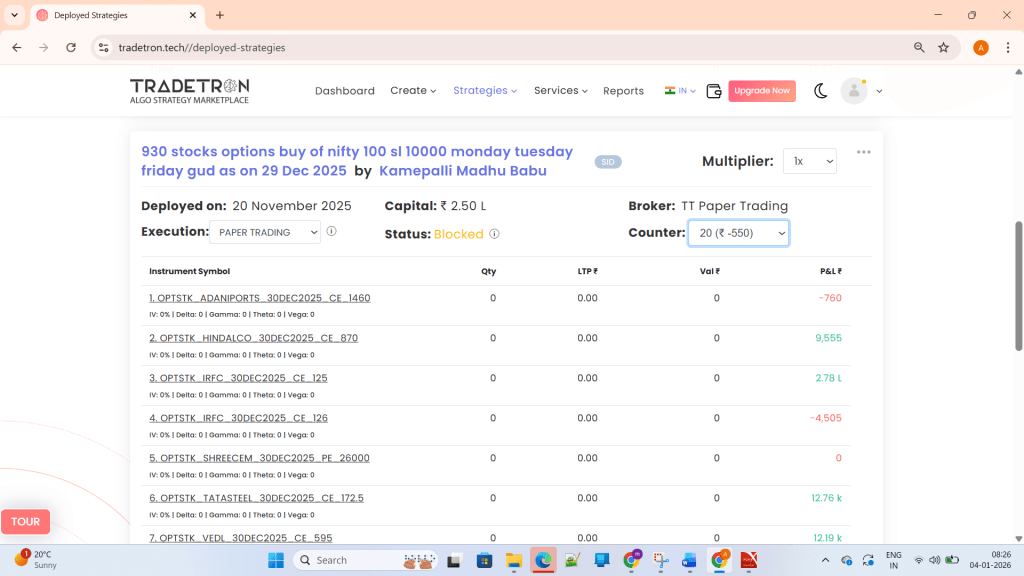
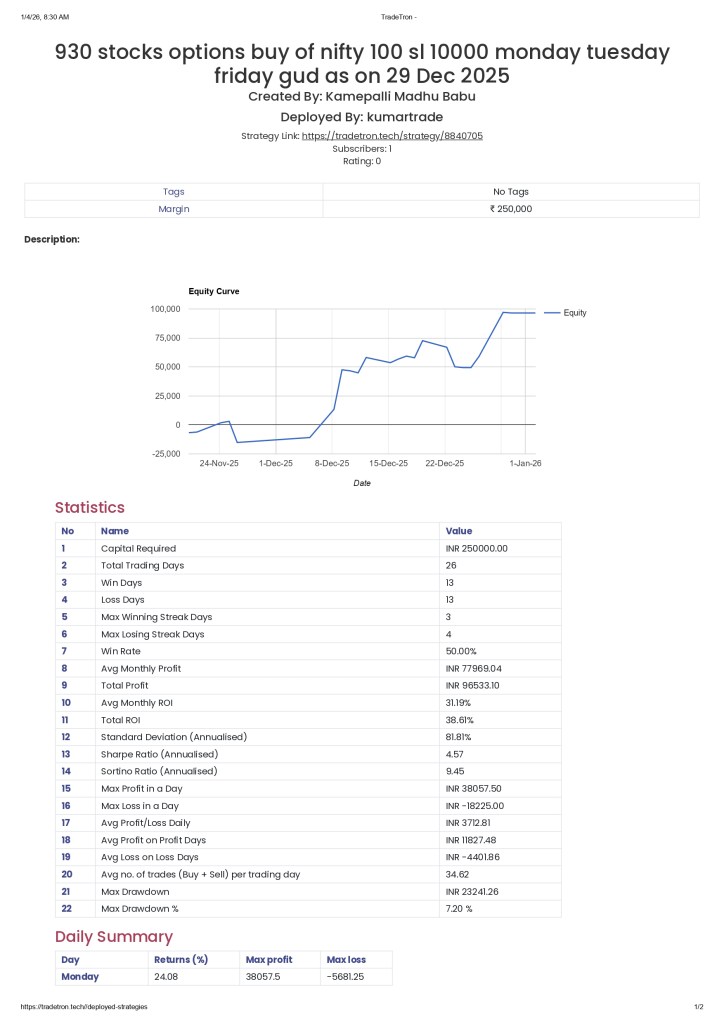
    The strategy in question was a 930‑stock options framework on NIFTY, designed to fire a large set of conditional orders with a ₹2.5L capital base in paper trading. The deployment ran smoothly for about 26 days, building a clean, continuous forward‑testing dataset and a healthy P&L trajectory.

    On monthly expiry day, however, the logic naturally became hyper‑active:

    • Multiple instruments met entry/exit conditions simultaneously.
    • The engine pushed a burst of orders in a short time window.
    • Tradetron’s internal risk/tech throttles classified this as “too many orders” and automatically shifted the strategy status to Blocked.

    From the platform’s perspective, this is a safety feature. From a systematic trader’s perspective, it is a data‑continuity nightmare.

    The Hidden Cost: Broken Equity Curves and Lost Context

    Once a strategy is in Blocked state, there is no graceful way to “resume” that same deployed instance. The standard workaround is:

    1. Delete the blocked deployment.
    2. Redeploy the same strategy afresh.

    The issue is not just inconvenience. The real damage is:

    • You lose the continuous forward‑testing record tied to that deployment.
    • Your equity curve is now split into before‑block and after‑block segments.
    • Any performance analytics (max DD, rolling returns, streaks) get skewed because they’re fragmented across instances instead of one continuous run.

    For traders who treat forward testing as seriously as live trading, this is unacceptable. The data is the strategy.

    Root Cause: Expiry Days and Order Bursts

    Why did this happen exactly on expiry? Because expiry days are structurally different:

    • Options decay accelerates; more conditions get triggered.
    • Volatility spikes intraday; stop‑losses and re‑entries fire more often.
    • Basket‑style or market‑wide strategies naturally generate order bursts.

    Platform‑level throttles don’t necessarily “understand” strategy intent—they only see order density, frequency, and technical constraints. When thresholds are crossed, the engine blocks the strategy to protect infra and possibly broker limits.

    So the failure was not in the trading logic, but in the interaction between your logic and the platform’s operational rules.

    The Simple, Powerful Fix: Pause on Monthly Expiry

    The elegant solution you arrived at is deceptively simple:

    Pause the strategy on the monthly expiry day to preserve the integrity of the deployment and its data.

    What this achieves:

    • Prevents expiry‑day burst from triggering a Blocked state.
    • Preserves the original deployment ID and full forward‑testing history.
    • Keeps your equity curve, drawdowns, and live testing stats continuous and analyzable.
    • Lets you treat expiry as a no‑trade risk‑day rather than a platform‑risk day.

    In practice, this turns expiry from a chaotic data‑breaking event into a deliberate “strategy rest day”.

    Turning Pain into a Robust Process

    This experience is more than a one‑off workaround; it is a template for building robust processes around systematic trading:

    • Platform‑aware design
      Don’t just design for market behaviour; design for how your platform behaves under stress conditions (rate limits, order caps, throttle logic).
    • Data‑first mindset
      Sometimes, skipping one high‑risk session (expiry) is worth it if it preserves a long, uninterrupted track record. Data continuity is an asset.
    • Pre‑planned off days
      Define in your playbook: days where the model could perform but structural or platform risks are too high—monthly expiries, certain event days, etc.
    • Operational rules as edge
      Most traders look for indicator edges; few optimize operational edges like when not to trade, how to avoid blocking, and how to preserve analytics.

    Conclusion: The Meta‑Edge

    The story of this blocked strategy is not about a “failure” but about an upgraded operating manual. The strategy logic worked. The platform did what it was designed to do. The gap was in anticipating that interaction on extreme days.

    By deciding to pause the strategy on monthly expiry instead of redeploying from scratch each time, I protected the most precious resource of any systematic trader: a clean, continuous, high‑quality data trail.

    In a world where everyone chases alpha in signals, sometimes the real meta‑edge is this: mastering the plumbing.

  • Tradetron’s Recurring “Price Zero” Error: My plans to Switch to AlgoTest

    Tradetron strategies often halt due to “instrument seems illiquid, price is zero” errors, like with Torntpharma, forcing manual intervention to resume trading. This issue stops all further condition checks for the day until users mark it “completed manually,” disrupting automated flows. The same strategies run flawlessly on AlgoTest with the identical broker, highlighting platform differences.​

    Error Details

    Notification logs show messages like “Torntpharma price is zero, seems illiquid,” appearing in both live and paper trading. Affected strategies display zero execution counts and error status on the dashboard, with capital locked at ₹200. Users must navigate to logs, manage the error, and manually complete it to proceed, a repetitive fix for multi-stock lists.​

    Why It Halts Trading

    Tradetron stops the entire strategy on any illiquid instrument detection, even if others are viable, unlike configurable skips in some platforms. Low liquidity in options or strikes triggers zero-price reads from broker data, common in equity options. This exposes traders to missed opportunities, as no further entries occur until reset.​

    Manual Workaround Steps

    • Access deployed strategies dashboard and click the three dots for the errored one.​
    • Select “Notification Log,” identify the zero-price entry, then “Manage Error.”​
    • Choose “Completed Manually,” ​
      This restores checking but requires daily monitoring, unsuitable for hands-off algo trading.youtube​

    AlgoTest Superiority

    AlgoTest handles the same Torntpharma strategy without errors, offering free backtesting, high customization, and no-coding strategy building. It provides detailed performance reports, real-time support, and multi-broker integration (35+), running smoothly where Tradetron falters. Users report easier interfaces and precise execution, ideal for commodities and options .

    Platform Comparison

    FeatureTradetron algotestAlgoTest algotest
    Error HandlingHalts on illiquid; manual fixContinues seamlessly
    BacktestingPaid plans required25 free weekly
    CustomizationHigh, some codingVery high, no-code builder
    SupportAdequateHighly responsive, real-time
    Cost StructureSubscription starts paidCredit-based, flexible
    User InterfaceTricky for beginnersIntuitive, all-in-one toolkit

    My Decision Ahead

    Raised the issue with Tradetron support; a fix would retain value for its automation. Without resolution, full migration to AlgoTest makes sense for reliability in live trading. Traders facing similar disruptions should test strategies cross-platform before scaling.