Tag: stock options

  • Navigating Monthly Expiry Challenges: Dhan Margin Glitch Limits Nifty Options Deployment

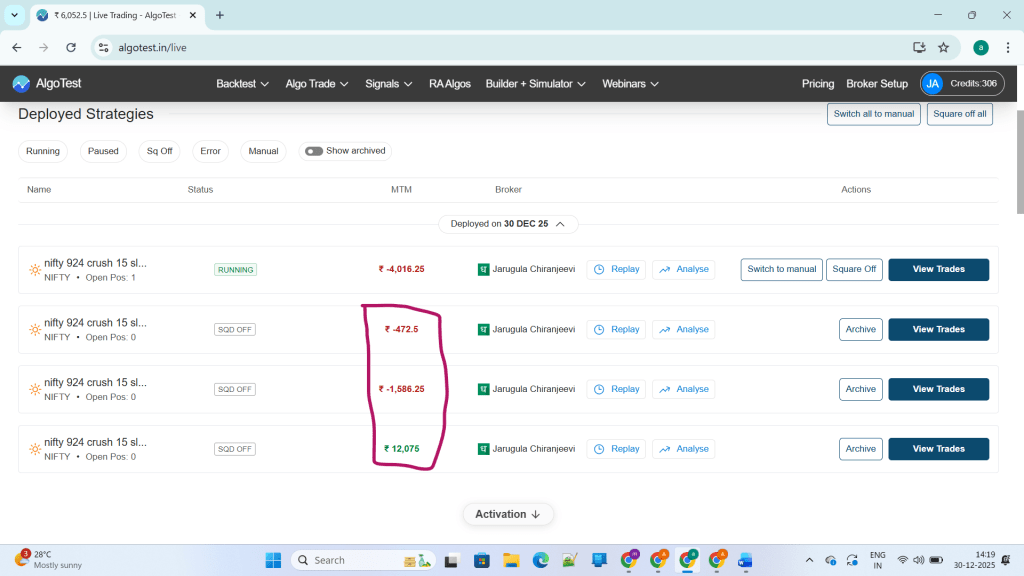
    On a monthly expiry day with no new intraday stock positions allowed, a switch to Nifty options trading revealed a frustrating margin utilization issue with Dhan broker. Despite ample pledged holdings showing as available margin, the system failed to deploy it fully, capping trades at 7 lots instead of the expected 15 based on total margin. A backtested strategy still delivered ₹12,000 in profits so far, highlighting resilience amid broker limitations.

    Pledged Holdings Margin Not Utilized

    Pledged holdings appeared as available margin in the Dhan account but were not applied to Nifty options trades during the session. This issue aligns with common Dhan complaints around MTF and pledge shortfalls, where explicit authorization or system delays prevent seamless use across segments like F&O. Traders must pledge holdings explicitly per SEBI rules, yet intraday glitches can block access despite sufficient collateral.

    Dhan vs Zerodha for Algo Trading

    Dhan offers free APIs, making it attractive over Zerodha’s ₹2,000 monthly fee, but margin reliability favors Zerodha for high-volume algo setups. Both provide similar intraday leverage (up to 5x), yet Dhan users report more pledge and shortfall issues during volatile expiry days. Zerodha’s established platform may justify the API cost for consistent margin use in Nifty options algos.

    Strategy Performance on Expiry Day

    The deployed backtested Nifty options strategy entered post-restrictions and hit ₹12,000 profits midway, proving robust for monthly expiries despite reduced lot size. Monthly expiries demand higher margins under SEBI’s 2025 rules, including 2% extra ELM on short options, which amplifies position sizing challenges. Final P&L awaits market close, but scaled-down deployment underscores the need for better broker.

    Broker Switch Considerations

    Future deployments may shift to Zerodha or alternatives  for better margin execution, weighing Dhan’s free APIs against reliability. Documenting such glitches builds empirical data for long-term broker evaluation, aligning with disciplined algo evolution.

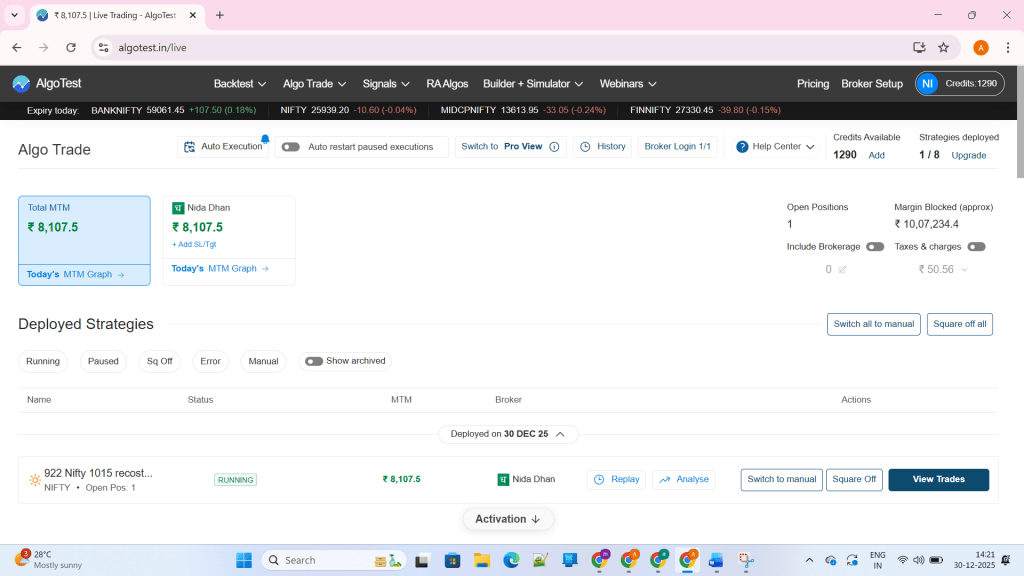
    the below screenshot is of the account for whom there is no error.


  • Extremistan Trading Triumph: Option Buys Crush Nifty 0.38% Down Day

    Today’s market delivered classic Extremistan asymmetry—Nifty shed 0.38% to 25,942 amid broad weakness, yet stock option buying strategies captured massive downside convexity in HindZinc and IRFC, generating outsized profits aligning with Nassim Taleb’s barbell philosophy. MCX commodities also showed mild profits today.

    Market Breakdown

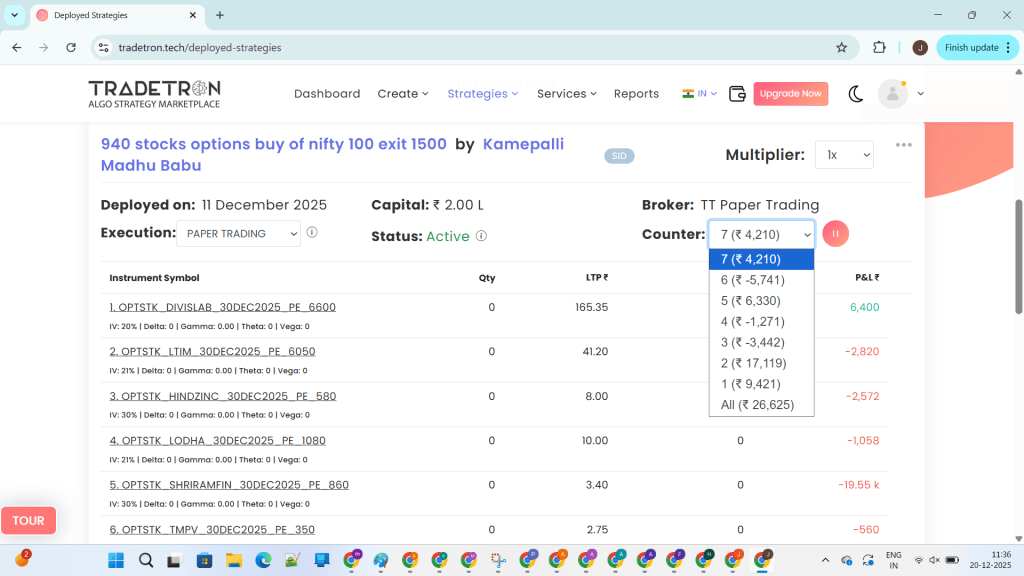
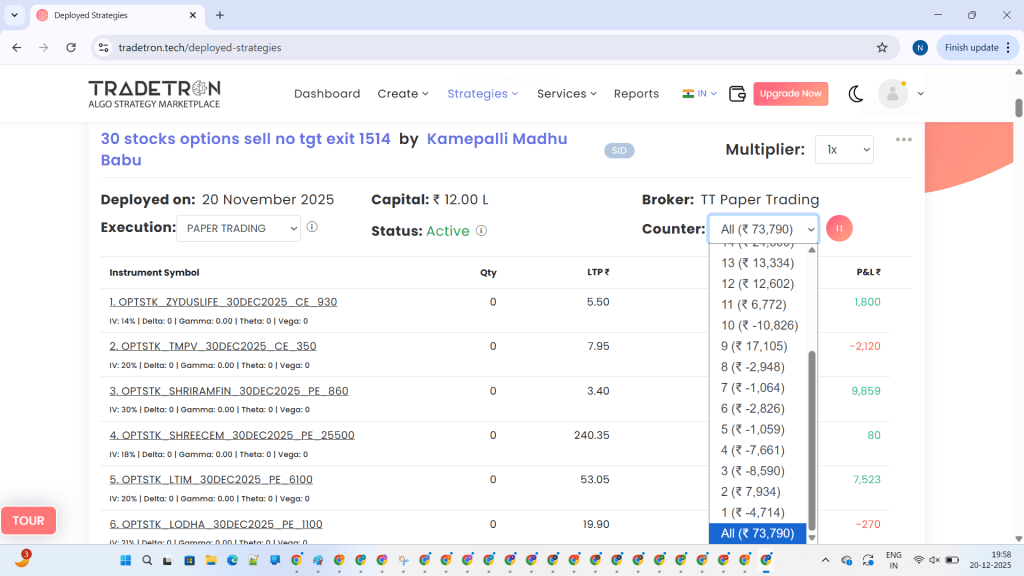
    Nifty closed down 100 points with Sensex off 346; metals reversed gains under global pressure while individual stocks decoupled sharply. Screenshot confirms HindZinc and IRFC as star performers on downside, with open profits reflecting precise entry timing. This validates option buying’s edge in fat tail events  

    Extremistan Edge

    Taleb’s framework shone: small bets on cheap OTM options explode during rare dispersions, as seen in today’s stock-specific drops versus flat index decay. My positions avoided theta bleed while convexity compounded; total P&L up despite Nifty’s 0.5% mild drag.

  • Monthly 30 percent returns strategy

    This blog post explains how the 9:40–14:59 intraday options strategy has evolved over the last month and what changes will be tracked over the next 30 days for further improvement.


    Strategy overview

    • The strategy enters trades after 9:40 a.m. and exits all open positions by 14:59 p.m. on the same trading day, making it a purely intraday.
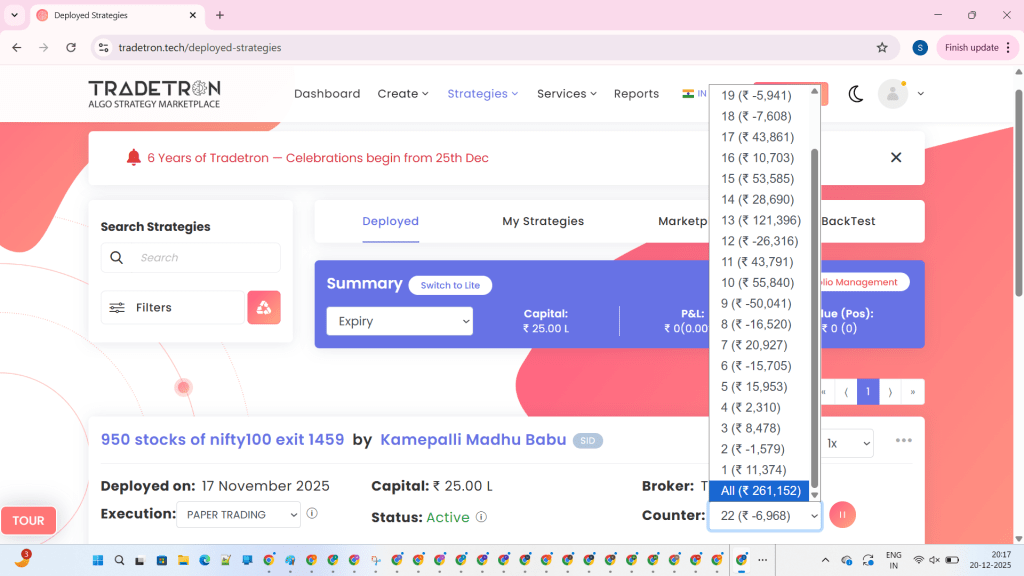
    • Recent paper‑trading results show strong returns with relatively small realised losses, indicating that the core edge of the strategy remains intact even before introducing new risk controls.

    Introducing overall stop losses

    • The strategy is now being tested with different overall stop‑loss caps of ₹4,000, ₹6,000, ₹8,000 and ₹10,000 per day, along with a version that runs without any overall SL for comparison.
    • Over the next 30 days, performance metrics such as net P&L, drawdown, win rate and average loss per day will be compared across these variants to understand how much protection each SL level offers versus the profit it potentially cuts.

    Fixing the “repair once” limitation

    • Initially, the strategy used only one repair block, which created problems when there were multiple entries because a “repair once” condition in Tradetron is evaluated just a single time for that leg.
    • To handle multiple partial exits and modifications correctly, separate repair blocks have now been created for each entry leg so that every position can be adjusted or squared off independently when its own conditions are met.

    Improving entry conditions with option‑based triggers

    • Earlier, entries in options were triggered by movements in the underlying stock or index, which caused execution issues whenever live data for some underlyings did not update properly.
    • The logic has now been shifted so that each option contract is traded based on its own price movement, ensuring that trades are taken only in option instruments where data is clean and reliable at the time of signal generation.

    Plan for the next 30 days

    • All variants of the strategy—different overall SL levels and the no‑SL version—will be deployed simultaneously to gather a robust 30‑day sample of trades across varied market conditions.
    • After this observation period, results will be analysed to finalise an optimal combination of daily overall stop loss and repair structure that preserves the strong profitability of the original model while reducing execution risk and drawdowns.

  • What is next when everyday 1%, 2% targets are hitting for my strategy


    Intraday trading in stock options looks glamorous from the outside, but the real edge comes from brutal honesty with data and the courage to refine a system step by step. Over the last month, a new basket of stock‑options strategies has been quietly doing exactly that in paper trading on Tradetron with a capital of ₹2 lakh per strategy. The early numbers are not just encouraging; they open up an important question every intraday trader must finally answer with evidence, not theory: should there be an overall portfolio stop loss?
    The journey so far
    These strategies were first deployed on 11 December 2025, focusing on buying stock options with leg‑wise stop losses for each stock. For ten consecutive trading sessions, they have been consistently hitting their intraday targets, which naturally builds confidence but also demands a deeper risk‑management framework.
    The stop loss dilemma
    From day one of intraday training, one lesson was clear: there is no certainty in the market, only probabilities. That is why leg‑wise stop losses were part of the design from the beginning, protecting each option position independently. Yet, until now, there was no overall SL for the combined strategy, meaning a sequence of losing trades on a volatile day could, in theory, create a deeper‑than‑necessary drawdown. The natural question arises: is a portfolio‑level stop loss good or bad for a system that is already performing well?
    Turning theory into data
    Rather than debating the answer in theory, the decision was made to let data speak over the next month. Multiple versions of the strategy have now been created with different overall stop losses: ₹1,000, ₹2,000, ₹3,000 and so on, all the way up to ₹10,000. Each variant will run in parallel on Tradetron, using the same underlying logic but with a different cap on maximum daily loss. At the end of the month, there will be a clear picture of how overall SL levels affect total returns, maximum single‑day loss, and the smoothness of the equity curve. The variant that offers the best balance of return and drawdown—not just the highest raw profit—will be the one chosen for live deployment.
    Fixing live‑trading obstacles
    This current phase is not just about SL experimentation; it is also the result of solving two practical obstacles faced during early live trading tests in stock options. The first issue was data‑feed related: sometimes the underlying moved, but the option LTP did not update as expected, causing stop losses to be skipped or entries to mis‑align. The solution was simple but powerful—make the entry condition depend on the option price itself, not just the underlying. If the option is not moving, there is no trade; if there is a trade, the option price is definitely live, so stops and targets behave as designed.
    The second hurdle was the imbalance between entries and repairs. Initially, the system could generate many entries but only a single repair, which meant that when the market gave fresh opportunities, the strategy could not fully participate. On one such day, this limitation translated into a painful missed profit. That limitation has now been removed by configuring multiple repairs—“as many repairs as entries”—so the strategy can actively manage positions throughout the day instead of firing once and staying passive.
    Why these screenshots matter
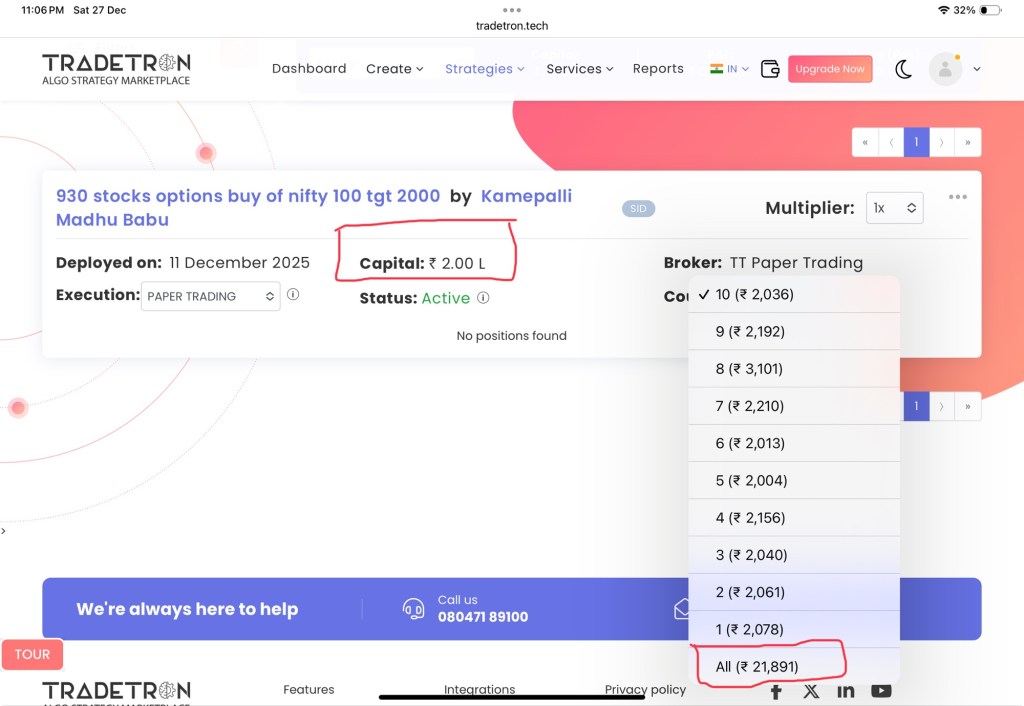
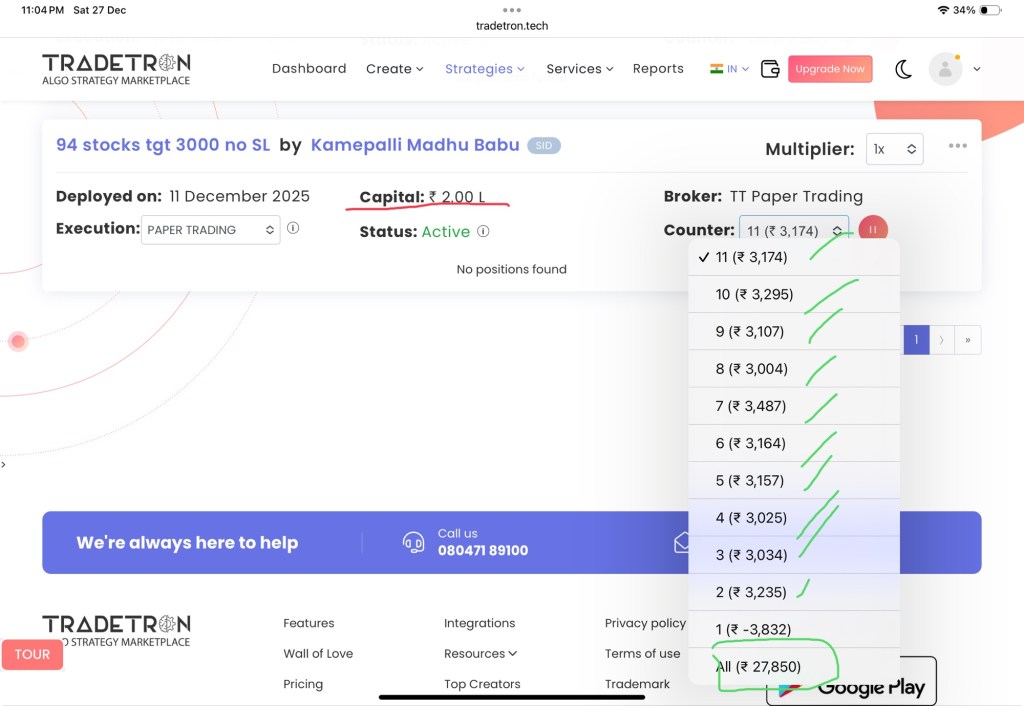
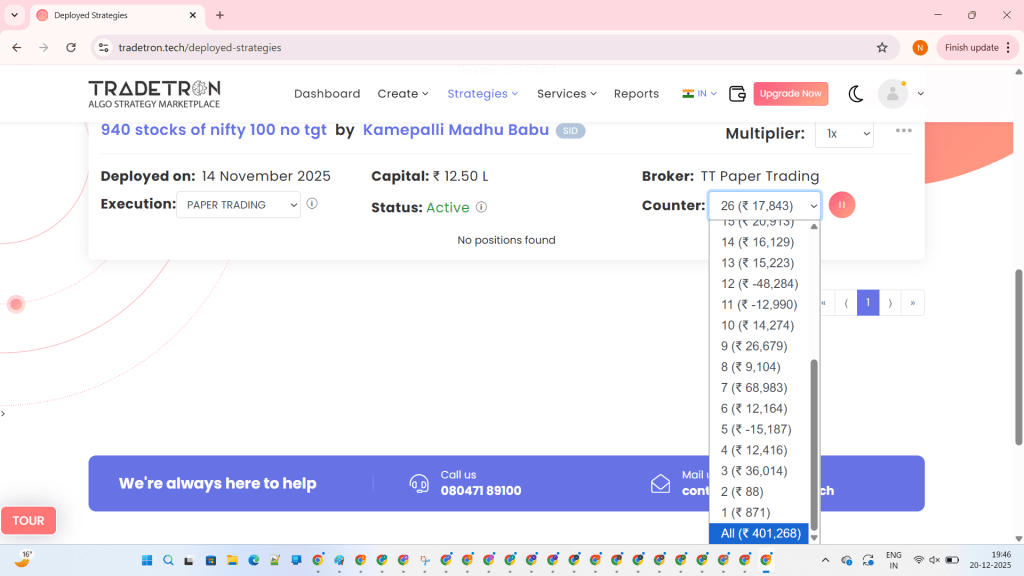
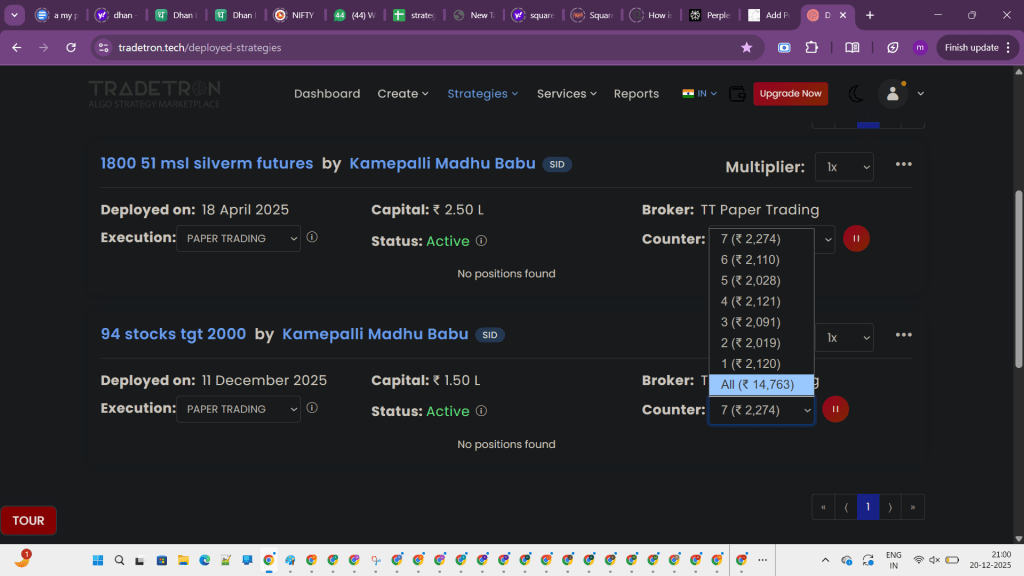
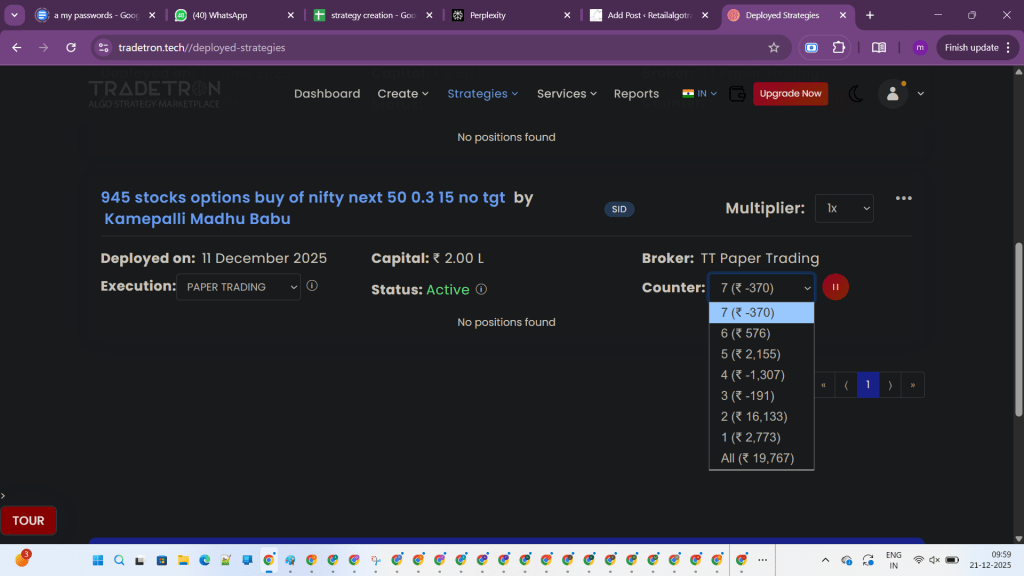
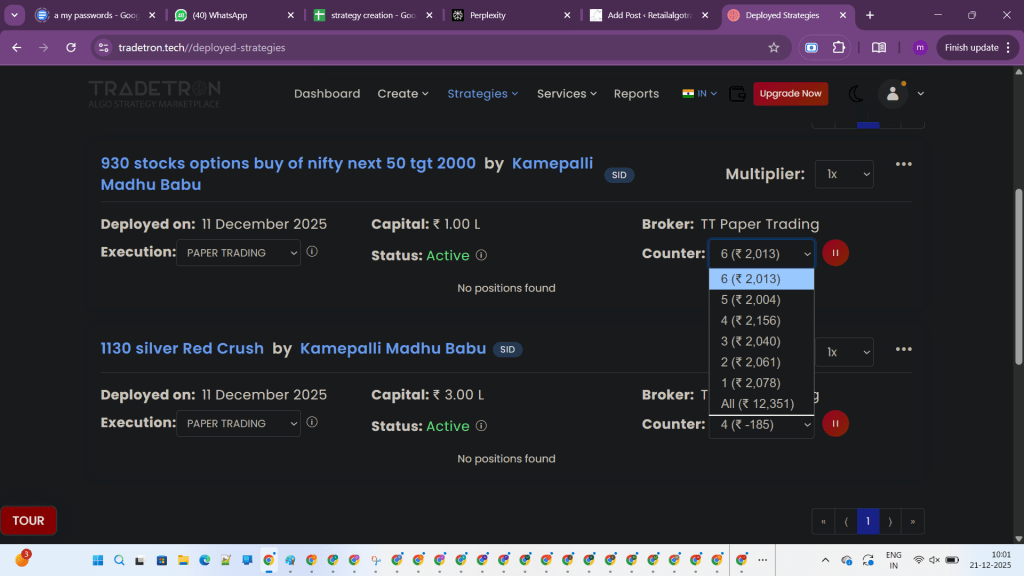
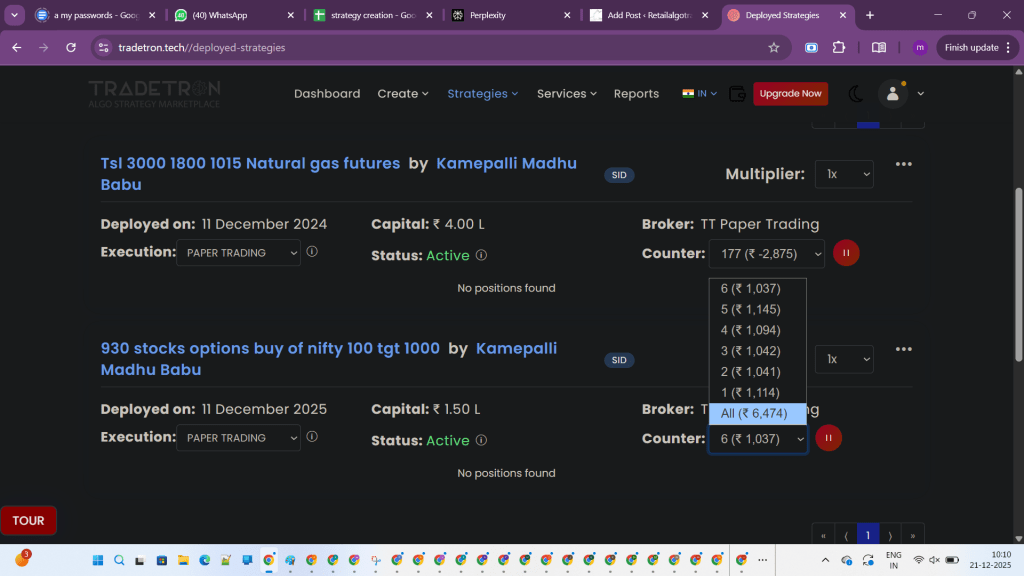
    The attached screenshots capture this evolution in numbers. The first shows the “930 stocks options buy of nifty 100 tgt 2000” strategy with a capital of ₹2 lakh and an overall P&L of around ₹21,891 across counters, a strong start for a system in testing. The second screenshot shows another variant, “94 stocks tgt 3000 no SL,” again allocated ₹2 lakh, already sitting on a larger cumulative profit of approximately ₹27,850 with multiple profitable counters marked. These images are not just proof of concept; they are the baseline against which the new SL‑based variants will be judged.
    Looking ahead
    The next thirty days will decide whether the hero remains the “no overall SL” version or whether one of the carefully chosen daily stop bands emerges as the more robust long‑term player. Whatever the outcome, the philosophy is clear: logic and theory are useful, but capital will ultimately follow the variant that proves itself in hard data. With leg‑wise SLs refined, option‑price‑based entries in place, and repair‑continuous logic fully aligned with the number of entries, these stock‑options strategies are now positioned to become genuine game‑changers in the intraday space.