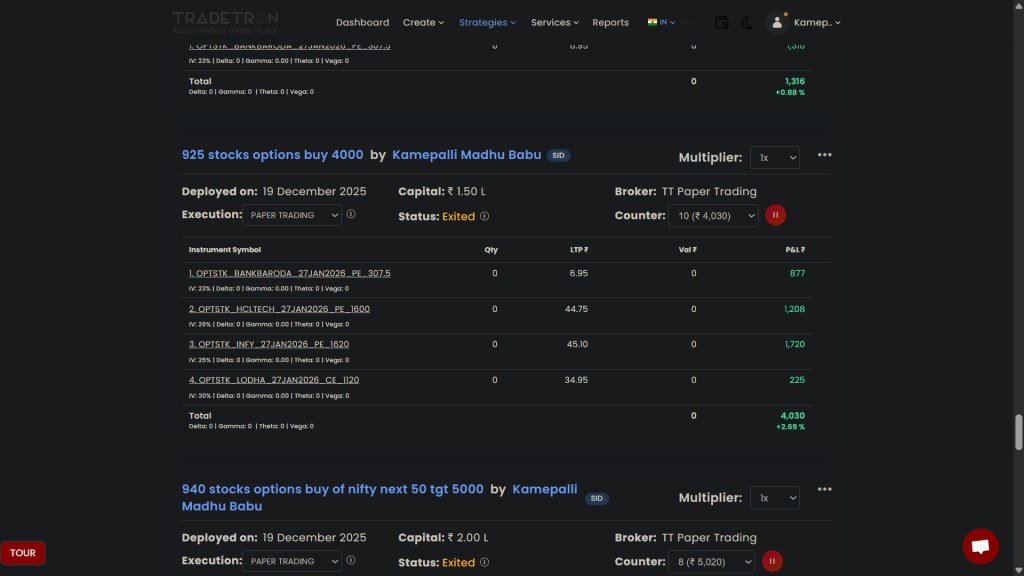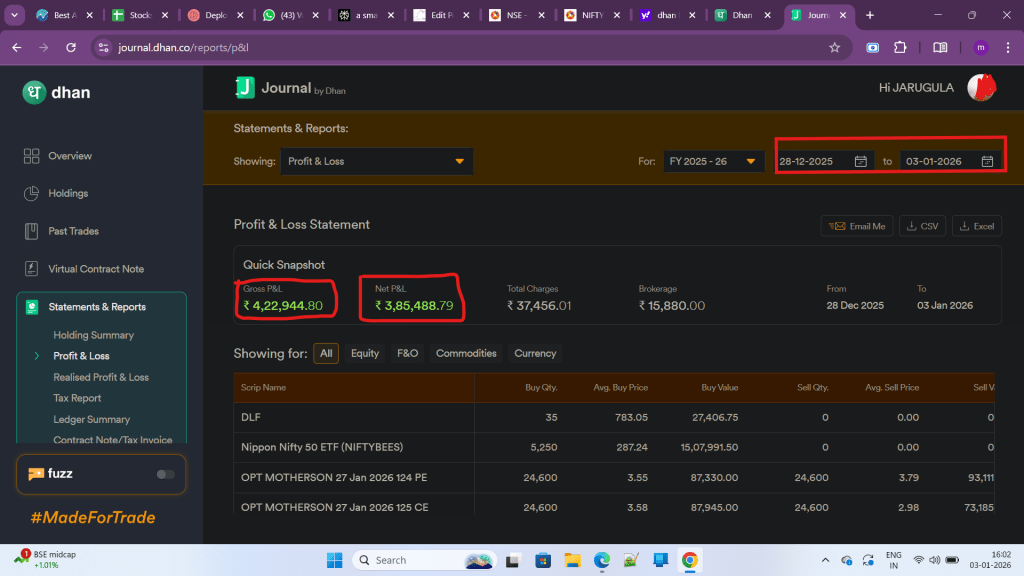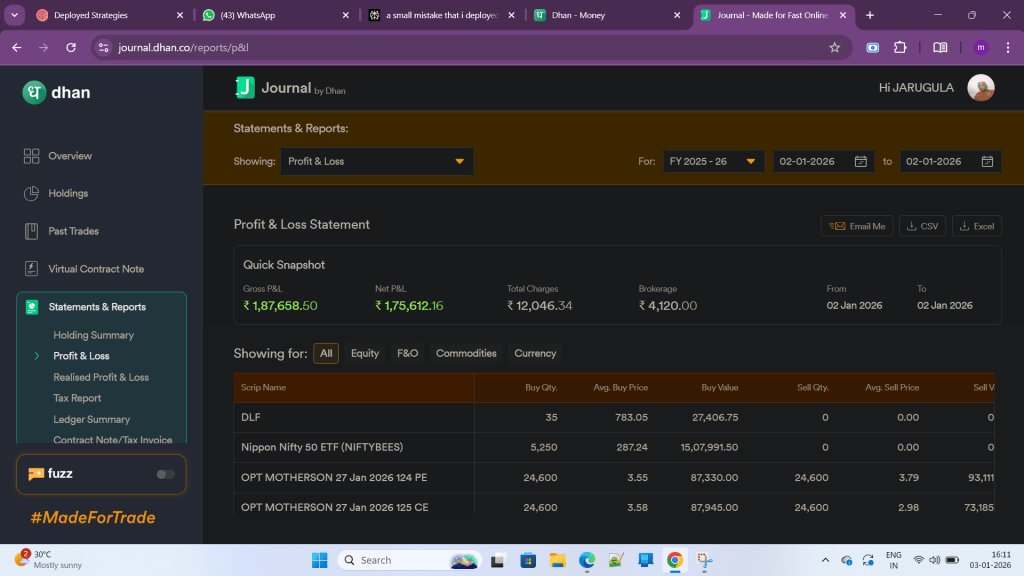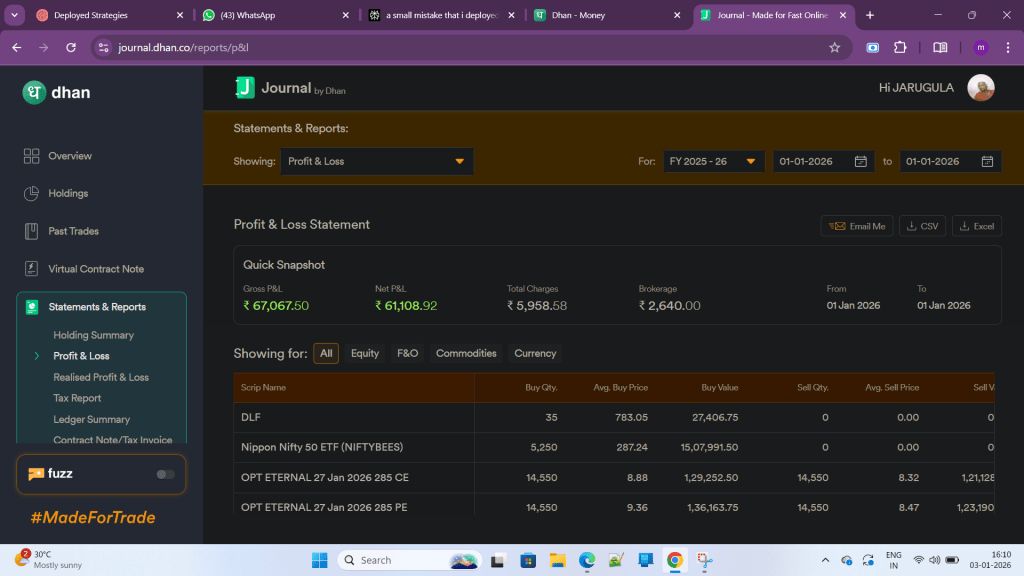
Tag: trading

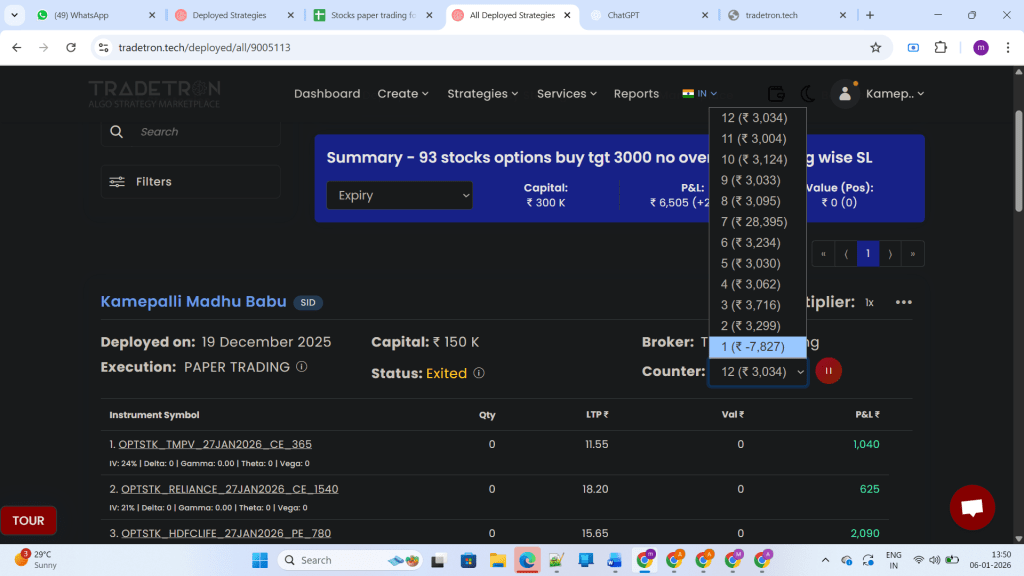
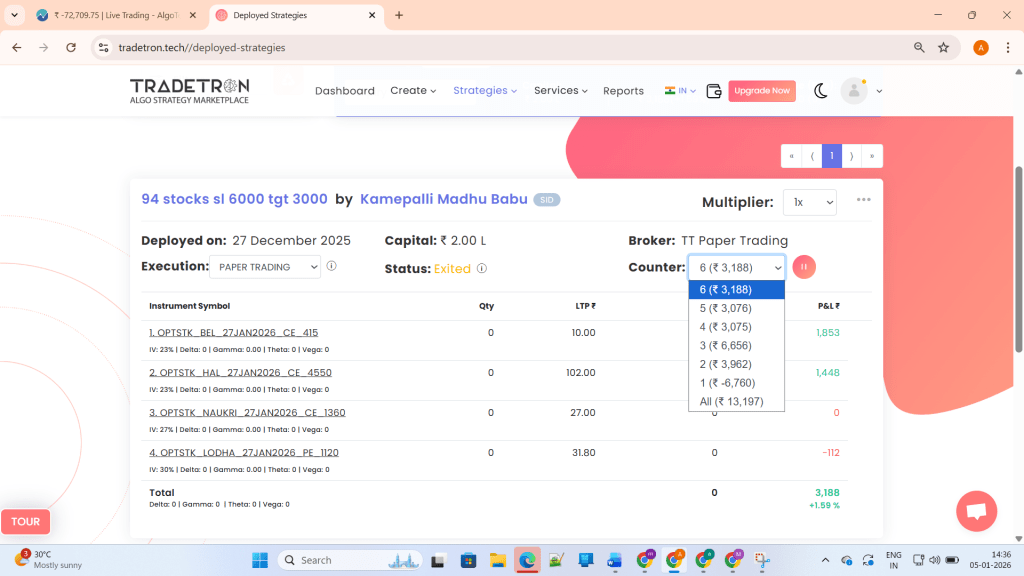
  • A Strategy That Quietly Does Its Job Every Day: ₹3,000 Target, Consistently Hit


    In algorithmic trading, consistency matters far more than occasional big wins. Anyone can show one good day. Very few can show daily discipline, controlled risk, and repeatable outcomes.

    Today, I want to share one such strategy—simple in concept, powerful in execution.


    🎯 Daily Target: ₹3,000

    📈 And It Has Been Hitting—Day After Day

    This 30 Stocks Options Buy Strategy is designed with a clear objective:

    • Small, achievable daily target
    • Strict risk management
    • Broad diversification across stocks
    • No over-optimization, no over-trading

    And the results speak for themselves.

    ➡️ Daily target of ₹3,000 has been consistently achieved, making it a strategy built for sustainable returns, not adrenaline trading.


    💼 Capital Efficient & Scalable

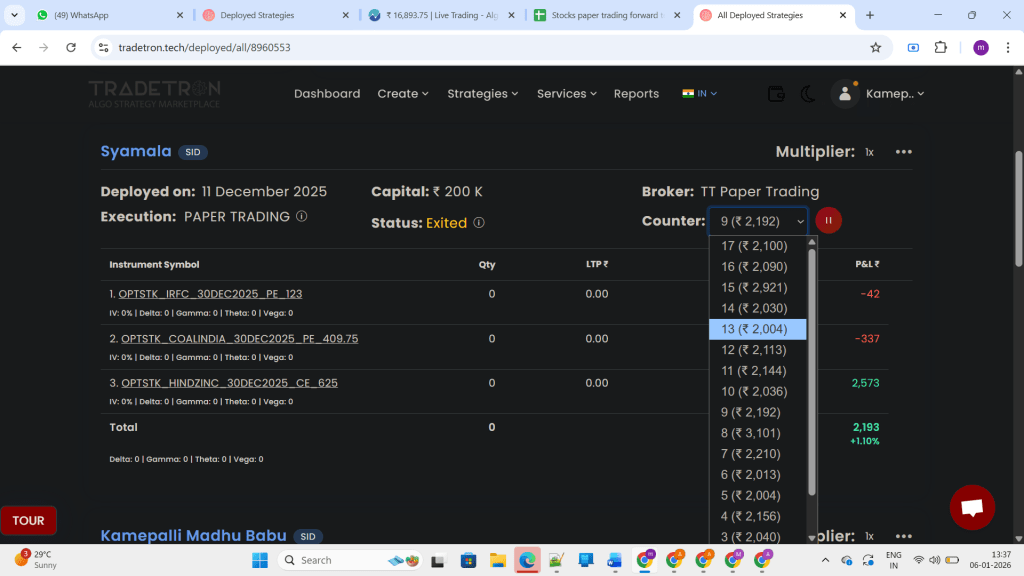
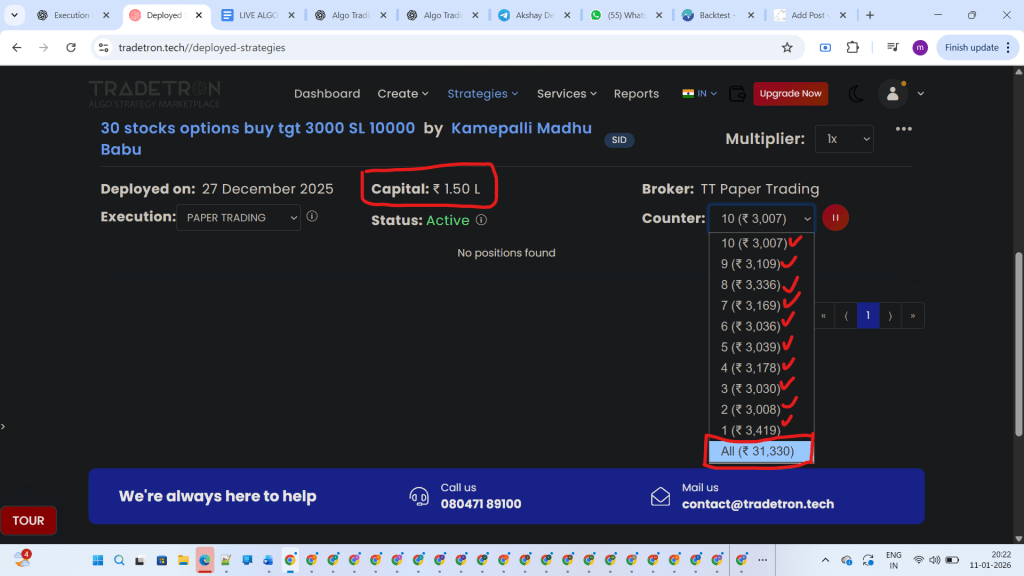
    • Deployed Capital: ₹1.50 Lakhs
    • Per-Stock Target: ~₹3,000
    • Execution Mode: Live & Paper (tested thoroughly)

    This makes the strategy:

    • Beginner-friendly
    • Capital-efficient
    • Easily scalable using multipliers

    Whether you’re starting small or planning to scale systematically, this strategy fits well into a disciplined trading framework.


    🔴 Live Deployed – Not Just Backtested

    This is not a theoretical setup or a cherry-picked backtest.

    The strategy is deployed LIVE
    Trades real market conditions
    Faces real volatility, RMS checks, and execution realities

    Transparency is non-negotiable.


    🔗 Strategy Details (For Serious Traders)

    You can verify, observe, and track the strategy yourself.


    🧠 Why This Strategy Works

    What makes this strategy stand out is not aggression—but structure:

    ✔ Diversification across 8 stocks
    ✔ Defined target & stop-loss
    ✔ No dependency on market direction
    ✔ Designed for calm, rule-based execution
    ✔ Minimal emotional interference

    This is the kind of strategy meant for traders who value peace of mind as much as profits.


    📌 For Whom Is This Strategy Ideal?

    This strategy is suitable for:

    • Traders tired of over-trading
    • Working professionals seeking passive algo income
    • Traders who prefer steady daily targets
    • Subscribers who value process over hype

    If your goal is to grow capital slowly, steadily, and responsibly, this strategy deserves your attention.


    🚀 Final Thoughts

    Markets reward discipline, not excitement.

    This strategy doesn’t shout.
    It doesn’t gamble.
    It simply shows up every day and does its job.

    If you’re looking to align with a tested, live-deployed, transparent algo strategy, you’re welcome to explore it using the shared link and code above.

    📊 Consistency compounds.
    📈 Discipline delivers.

    Kamepalli Madhu Babu
    Algo Trader | Strategy Designer |
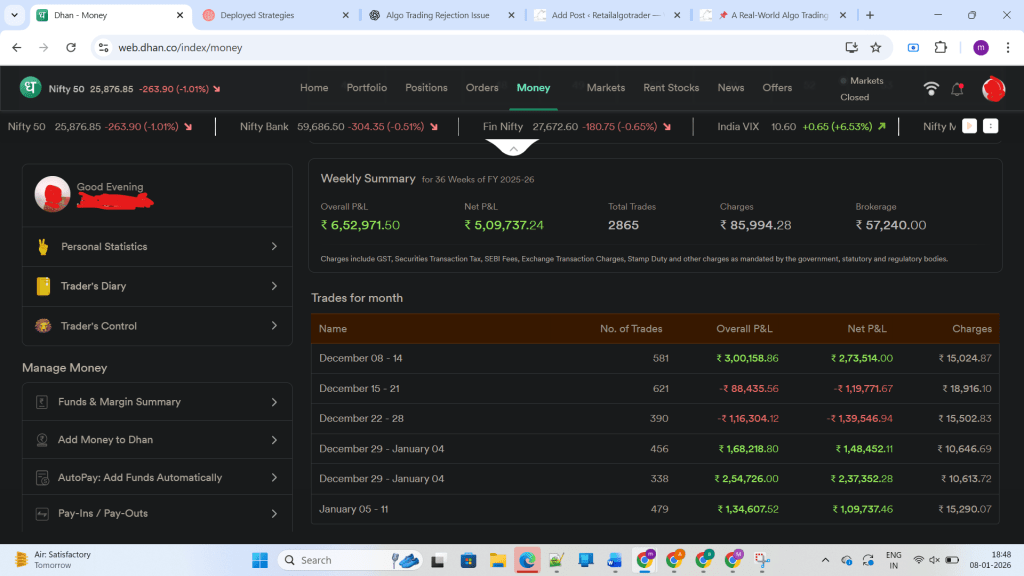
  • 📊 Six Weeks, ₹5 Lakhs Net P&L — And the Truth Behind the Numbers

    Dear Subscribers,

    I want to share a clear, unfiltered view of what has happened in my trading over the last six weeks—not just the results, but the real process behind them.

    📈 The Headline Number

    • Net P&L (last 6 weeks): ~₹5,00,000
    • Capital deployed: ~₹35,00,000

    These results did not come in a straight line.


    🔻 Two Consecutive Losing Weeks — Yes, That Happened

    Out of the last six weeks:

    • Two weeks were consecutive losing weeks
    • Losses were not only market-driven
    • A significant portion came from execution and system-level issues

    This is important to understand because real algo trading is not just about strategy logic—it’s also about execution reliability.


    ⚙️ The Problems I Faced (Openly Explained)

    Over these weeks, I encountered multiple challenges:

    1️⃣ Execution Errors (Platform & Coding Level)

    • Orders not firing as expected
    • Partial deployment (e.g., 4 stocks instead of intended 8)

    2️⃣ Repair Logic Limitations (Earlier)

    • Initially, only one repair entry was coded
    • Strategy required continuous repair, not a single repair
    • This was fixed by implementing a continuous repair function

    3️⃣ Market Data Issues

    • Stock prices not updating continuously
    • This affected targets and stop-loss execution
    • I attempted to shift logic to option-price-based execution
    • That approach could not be fully implemented due to platform constraints (Tradetron)
    • but Algotest platform solved the above issue.

    4️⃣ Manual Intervention Became Necessary

    • Whenever an error occurred, I manually repaired and completed the trade
    • Strategy logic continued, but…
    • This required continuous monitoring, which is not ideal but became necessary during system evolution

    🧩 Platform Reality: Why I Use Both Tradetron & Algotest

    • Many of the above issues are significantly reduced on Algotest
    • Some issues still exist on Tradetron
    • As of now, I am running strategies on both platforms
    • No emotional decisions, no sudden shifts—only measured evaluation

    This is real trading, not marketing trading.


    🧠 A Very Important Clarification

    Let me be absolutely clear:

    I am NOT saying
    “There will be no more losing weeks.”

    That would be dishonest.

    What I am saying is:

    • The specific problems I faced
    • The solutions I implemented
    • The lessons I learned

    Losing weeks—and sometimes even losing months—are normal and unavoidable in systematic trading.

    They are not a failure of strategy or discipline.
    They are part of the strategy lifecycle.


    📚 Continuous Learning Is Non-Negotiable

    I still consider myself a continuous learner of the markets.

    Every issue I faced:

    • Made the system stronger
    • Improved risk awareness
    • Enhanced execution discipline
    • Increased transparency with subscribers

    Markets evolve.
    Platforms evolve.
    Strategies must evolve.

    And so must the trader.


    🤝 Why I Share All This With You

    Because you are not just following signals—you are:

    • Participating in a real trading journey
    • Experiencing real drawdowns
    • Benefiting from real system improvements

    There are no perfect equity curves.
    There are only honest traders who adapt.


    🧘 Final Thoughts

    Profits bring confidence.
    Losses bring clarity.
    Survival brings mastery.

    We will have winning weeks.
    We will have losing weeks.
    What matters is process, risk control, and transparency.

    Thank you for trusting the journey—not just the results.

    Madhu Babu
    Algo Trader | Strategy Developer | Continuous Student of Markets

  • 📌 A Real-World Algo Trading Reality: One Trade Executed, One Trade Rejected

    Dear Traders & Subscribers,

    Today I want to openly share an important live trading incident that happened in my account, because transparency is a core value of how I run and share my strategies.

    This is not a complaint post, not a justification, and not an excuse.
    This is a reality check of algo trading through demat accounts in live market conditions.


    🔍 What Exactly Happened?

    • Same broker: Dhan
    • Same underlying: Bajaj Holdings
    • Same strike: 11600 PE
    • Same expiry
    • Same market session
    • Time difference: barely 4 minutes

    But…

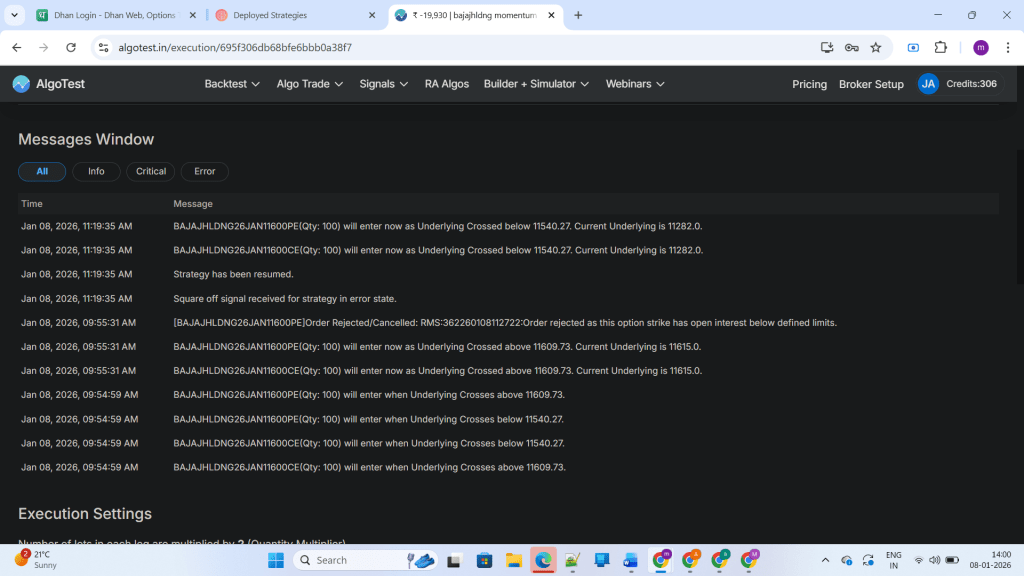
    • Order placed via Tradetron → Executed successfully
    • Order placed via Algotest → Rejected

    The rejection message received was:

    “Order rejected as this option strike has open interest below defined limits.”

    This rejection eventually resulted in a missed opportunity of ~₹40,000.


    🧠 The Confusion Everyone Faces

    After this incident, I heard multiple explanations from different sides:

    • Some say liquidity issue
    • Some say broker RMS (Risk Management System)
    • Some say exchange-level OI limits
    • Some say algo platform handling
    • Some say timing & order routing

    👉 The truth is:
    Retail algo traders don’t always get one single clear answer immediately.

    And that itself is part of live trading reality.


    ⚠️ Important Point to Understand

    This was NOT:

    • A strategy failure
    • A logic error
    • A wrong signal
    • A manual execution mistake

    This was a system-level rejection, something that can happen when:

    • OI thresholds dynamically change
    • RMS checks vary by microseconds
    • Exchange risk filters activate suddenly
    • Platforms route orders differently even with the same broker

    Algo trading is not a backtest environment.
    Live markets are messy, fast, and imperfect.


    🧩 Why One Platform Worked and the Other Didn’t?

    This is the most common question.

    Even when:

    • Broker is same
    • Instrument is same
    • Strike is same

    👉 Order routing, validation timing, RMS checks, and exchange responses can differ between platforms.

    A few minutes, few seconds, or even milliseconds can make a difference.

    This is not widely discussed on social media—but it’s the truth.


    📣 My Stand as of Now

    • I have raised this issue with Algotest
    • Their team is investigating the root cause
    • I am not jumping to conclusions
    • I am not changing broker or platform in panic
    • I am continuing trading as usual

    Why?

    Because professional trading is about handling uncertainty, not running away from it.


    💡 What I Want Subscribers to Take Away

    1. Algo trading is powerful, but not perfect
    2. Execution risks exist, even with the best setup
    3. Losses can come from systems, not strategies
    4. Risk management must include execution risk
    5. Emotional decisions after one incident are dangerous

    Today it cost me money.
    Tomorrow it might save me money.

    This is the game.


    🤝 Transparency Above Everything

    I believe trust is built when realities are shared, not just profits.

    You are not following a fantasy system.
    You are following real strategies traded in real accounts with real challenges.

    I will update you once I get clarity from Algotest.
    Until then, we trade calmly, logically, and professionally.


    Final Thought

    Markets don’t reward perfection.
    They reward those who survive imperfections.

    Thank you for standing with me in both profits and realities.

    Madhu Babu
    Algo Trader | Strategy Developer | Real Market Participant

  • Consistently Target-Hitting Algo Strategies – Live & Transparent


    Dear Subscribers,

    I hope you’re doing well.

    I’m reaching out to invite you to deploy a set of my consistently target-hitting option strategies that have been performing with discipline and clarity across recent market conditions.

    Over the past sessions, these strategies have demonstrated:

    • Consistent target achievements
    • 📊 Rule-based execution with controlled risk
    • 🔁 Repeatable performance across multiple stocks
    • 🧠 No discretionary interference – pure system-driven trades

    For your complete transparency and confidence, I’m enclosing:

    • 📸 Actual strategy screenshots
    • 🔗 Direct strategy links
    • 🟢 Live shared deployment codes
    • 📈 Detailed strategy statistics & counters

    These are not one-off lucky trades. They are process-driven systems built with a clear understanding of market behavior, volatility, and capital protection. Every entry, exit, and target is pre-defined.

    Why consider deploying these strategies?

    • Designed for consistency over excitement
    • Suitable for traders who value discipline and probability
    • Continuously monitored and refined
    • Fully automated execution support

    ⚠️ Disclaimer:
    All strategies are shared for educational and deployment purposes. Market risks are inherent, and past performance does not guarantee future results. Please deploy only after reviewing the strategy logic and ensuring it aligns with your risk appetite.

    If you believe in process-driven trading and are looking to participate in strategies that respect risk as much as returns, I’d be glad to have you on board.

    Feel free to go through the enclosed details, and I’ll be happy to clarify anything or guide you through deployment.

    Warm regards,
    Kamepalli Madhu Babu
    Algo Strategy Developer & Trader


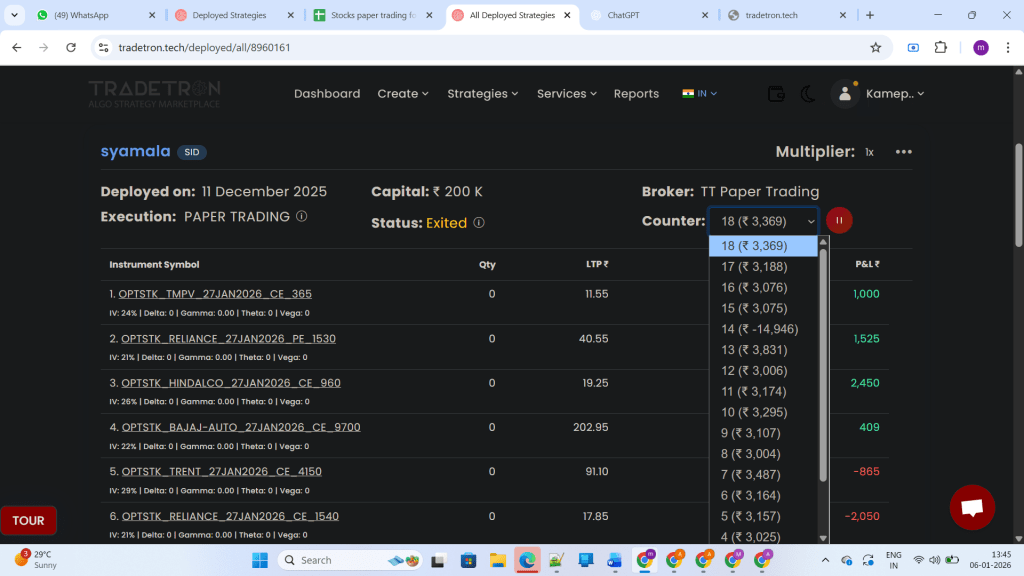
    https://tradetron.tech/strategy/8960161

    https://tradetron.tech/strategy/9005113

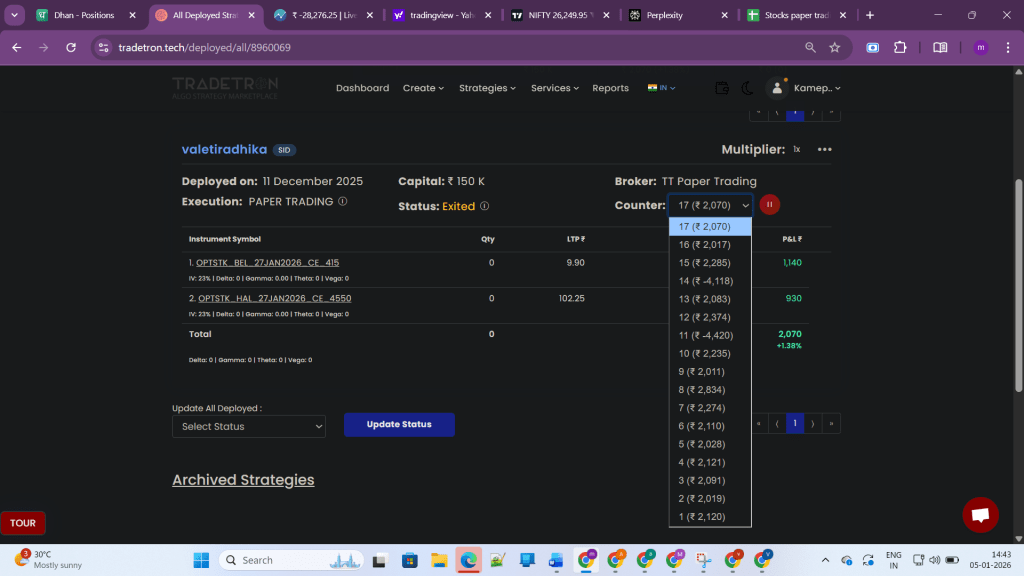
    https://tradetron.tech/strategy/8960069

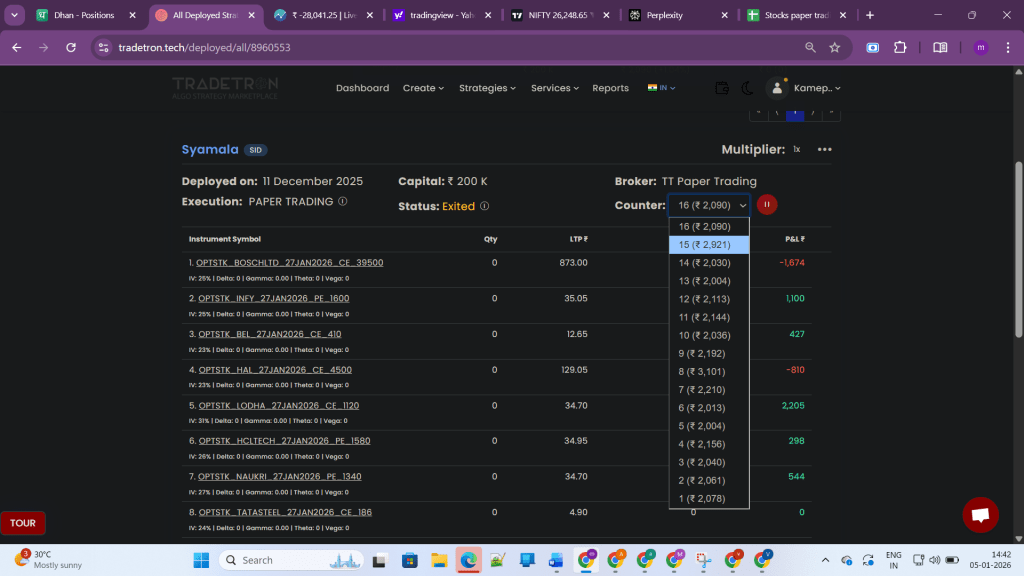
    https://tradetron.tech/strategy/8960553

    here are the shared codes

    31a67994-2f61-42b5-8683-9e837da4b432

    639826ac-5de6-4db2-a809-0875b4c5f2dc

    597fdb9c-1c08-4db5-b092-43484c5dae9d

    99e27717-f1db-46fd-aa5b-bbd6264dc257

    how to use shared codes video link is provided below

  • Targets Don’t Care About Market Mood

    Date: 05 January 2026
    Market: NIFTY 50 (Sideways Session)


    When the Market Refused to Trend

    Today’s market was anything but generous. The NIFTY moved sideways, lacking conviction, momentum, or follow-through. It was the kind of session where impatience gets punished and overconfidence gets exposed.

    Yet, amid this dull and compressed price action, something important happened.


    The Outcome That Matters

    All predefined targets were hit.

    Not hypothetically. Not on hindsight charts.

    Every single target level—₹2,000, ₹3,000, ₹4,000, and ₹5,000—was achieved today.

    And this deserves to be highlighted clearly:

    These targets were hit in a sideways market, not a trending one.


    Why This Is Significant

    Most traders believe profits come only when markets trend strongly. Days like today prove otherwise.

    This performance was not driven by:

    • Luck
    • Aggressive position sizing
    • Hope-based holding

    It was driven by:

    • Well-defined entry logic
    • Strict risk management
    • Realistic, probability-based targets

    When strategies are designed correctly, they don’t need the market’s mood to cooperate.


    Breaking the Myth: “Sideways = No Money”

    Sideways markets don’t eliminate opportunities.
    They eliminate undisciplined traders.

    Today clearly demonstrated that:

    • Small targets compound
    • Discipline outperforms prediction
    • Process beats emotion

    A Note on Risk and Professionalism

    Equally important is what did not happen today:

    • No overtrading
    • No revenge trades
    • No violation of rules

    Some strategies booked small expenses, as expected in a sideways session—but target-based strategies delivered exactly as designed.

    This balance between booking expenses and booking profits is what keeps the equity curve stable.


    Message to Subscribers

    If you traded today and felt the market was slow, confusing, or boring—remember this:

    The market doesn’t need to trend for disciplined systems to pay.

    What matters is:

    • Trusting the process
    • Respecting position sizes
    • Letting targets do their job

    Today was not about excitement.
    It was about execution.

    And execution delivered.


    Closing Thought

    Markets will have trending days.
    Markets will have sideways days.

    But targets remain targets—independent of noise, news, or narrative.

    Today reaffirmed a simple truth:

    When your system is right, consistency replaces prediction.

    We stay patient.
    We stay disciplined.
    And we keep hitting targets—one session at a time.

    Kamepalli Madhu Babu

  • Last Week’s P&L Was Great. The Real Win Was the Mindset. Profits should change the equity curve, not the trader’s character

    A Strong Week, But Not “Unlimited Joy”

    Last week’s numbers were impressive: multiple days of solid green, with only Tuesday left on the table because fresh stock-option positions were not allowed on monthly expiry day due to physical settlement rules. On the first three days, only 3 lots per stock were deployed, and on the last two days, the exposure was scaled up to 6 lots, which naturally amplified the absolute profits.

    Yet this is not the time for unlimited celebration. It is just one phase in a normal market cycle where strong trending weeks and dull, directionless weeks keep rotating. Treating a good week as “normal business” rather than a jackpot keeps a trader grounded and protects against overconfidence.

    The Tuesday That Got Away

    On Tuesday, the strategy signalled trades, and forward testing also showed strong potential performance, but the exchange’s restriction on fresh stock-option positions on monthly expiry day meant no new trades could be taken. The system did its job in forward testing (paper trading) well.

    This is an important psychological reminder. Some missed profits are not “mistakes” but structural constraints of the derivatives market, especially around physical-settlement expiries, and accepting that calmly is part of being a professional trader.

    Lots, Risk, And Normalizing Big Numbers

    Deploying 3 lots initially and then 6 lots later in the week was a deliberate way to scale risk as confidence in live behaviour increased. The higher lot size naturally made the last two days look spectacular on the statement, but in reality it was the same underlying edge with a slightly larger position.

    Professional trading means normalizing big P&L numbers emotionally. Profits should change the equity curve, not the trader’s character; the real metric is how faithfully the plan was executed at each lot size.

    Targets Versus Open-Ended Profits

    Last week also highlighted a deeper structural choice: comfort versus returns. Some strategies were run with fixed profit targets of 2,000–3,000, and these targets were hit reliably, giving psychological comfort and quick closure. However, those same targets also capped “bomblastic” moves where the market kept trending, and the system would have delivered far larger profits without a hard cap.

    In parallel, a set of target‑less strategies was running, allowing profits to trail and breathe, and these captured a much bigger portion of large moves, at the cost of enduring more open fluctuation. This side‑by‑side experience made one truth crystal clear: if the goal is long‑run capital growth, open‑ended exits with intelligent risk management beat small, comfortable caps.

    From Comfort To Conviction

    Trading literature has always emphasised letting winners run and avoiding premature profit booking, and many classic strategy authors advocate exits that maximise expectancy rather than emotional relief. But real conviction in that idea only comes when a trader sees, in personal forward testing, how much upside is left on the table by rigid profit targets.

    That is why the next phase is clear: target‑based variants will be kept only in forward testing or paper trading, while live capital will increasingly be allocated to robust, well-tested strategies without hard profit caps, supported by disciplined position sizing and risk controls. The mission now is simple: — to keep sieving through every statistic, every weekend, until the portfolio is dominated by strategies that may not feel the most comfortable in the moment but deliver superior returns over the long run.

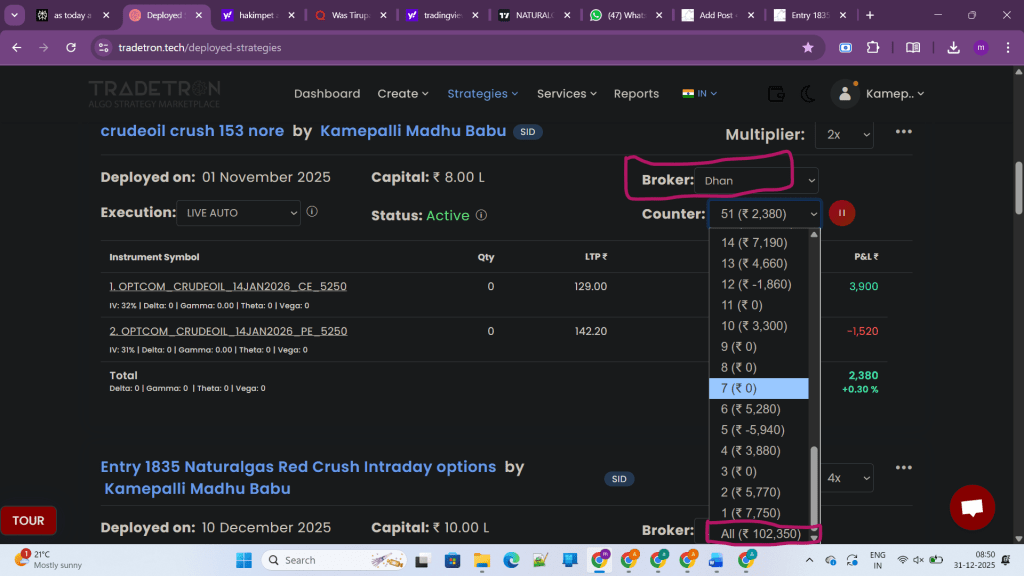
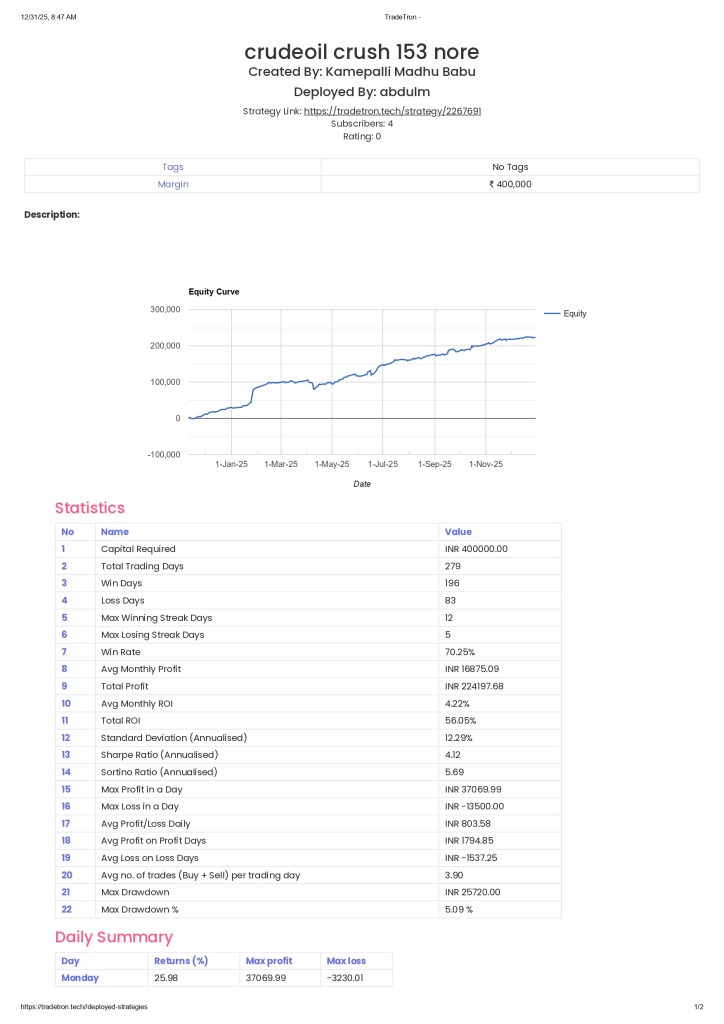
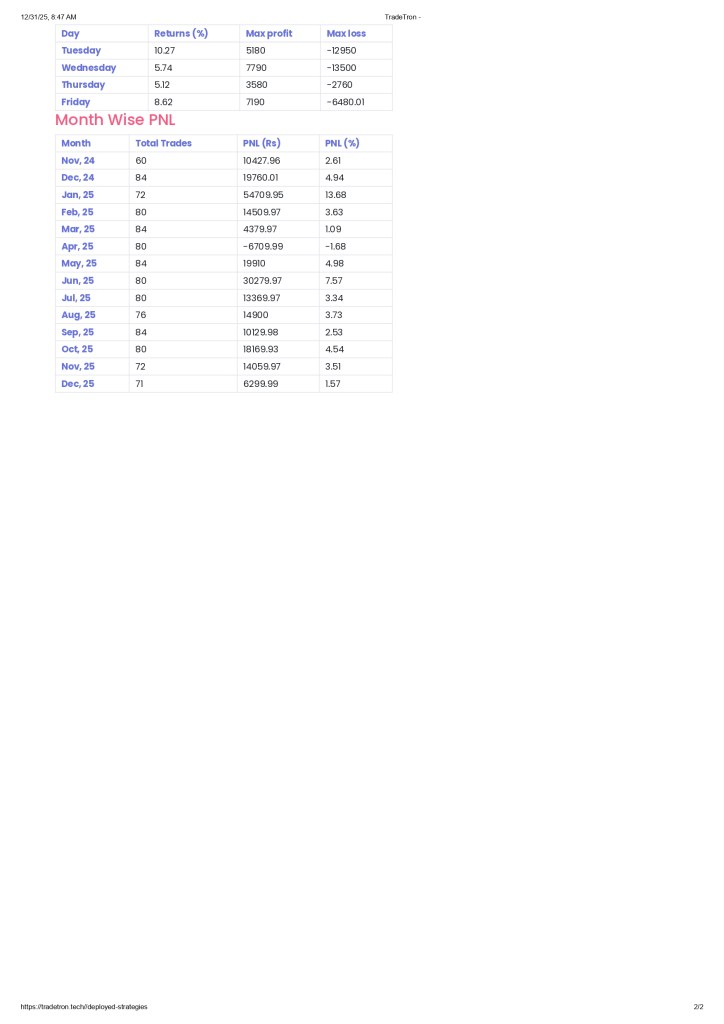
  • Crude Crush 1530 stands as the most reliable strategy in live deployment over the past year on Tradetron with Dhan broker, crossing ₹1 lakh in profits as of December 31, 2025. This intraday crude oil options system targets MCX evening volatility, delivering consistent execution in real-market conditions.

    Proven Live Performance

    Deployed continuously for 12 months, Crude Crush 1530 has generated over ₹2,27,000 in verified profits, showcasing resilience across crude oil’s volatile swings. The dashboard reveals multiple successful legs with positive P&L on key dates like November and December 2025, confirming real-time profitability beyond paper trading(Forward Testing). Evening session focus aligns with peak MCX liquidity from 3:30 PM to 11:30 PM, where global crude moves create premium opportunities.

    Strategy Mechanics

    This intraday options approach enters crude oil positions post-1530 IST, capitalizing on US session overlap for momentum and mean-reversion setups. Automated via Tradetron-Dhan integration, it handles multi-leg executions (e.g., 2-4 lots) with Dhan’s multiplier. Risk controls include time-based exits before session close, avoiding overnight gaps from EIA reports or OPEC news.

    Edge in Crude Oil Trading

    Crude oil’s high volatility suits this system’s premium capture, outperforming in range-bound and breakout regimes common to MCX evenings. Live stats show strong win rates on deployed legs, with Dhan enabling efficient collateral use.

    Deployment Advantages

    Full Tradetron automation removes emotional bias, with Dhan’s free APIs handling live execution seamlessly for MCX options. Strategy suits working professionals targeting evening crude moves, backed by one-year empirical data over diverse market conditions.

    Mandatory Disclaimer and Risks

    Past performance does not guarantee future results. This strategy faced drawdowns and will encounter losing periods; crude oil volatility can spike unexpectedly from geopolitical events, inventory data, or USDINR shifts. Trading derivatives involves substantial risk of capital loss; slippage, broker issues, and margin calls can erode profits. Not investment advice—consult a SEBI-registered advisor, trade only risk capital, and review all risk disclosures before deployment.

    https://tradetron.tech/strategy/2267691

  • Entry 1835 Naturalgas Red Crush Intraday Options

    Entry 1835 Naturalgas Red Crush Intraday Options has delivered more than 60% win rate and over 5% monthly returns in the evening session since May, making it a compelling MCX options strategy for systematic traders. Yet every trader must remember that these outcomes are historical; past returns do not guarantee future performance, and capital is always at risk.

    Strategy Concept and Market Focus

    This strategy trades natural gas options on MCX, targeting the evening session when liquidity and volatility typically rise. Natural gas’s intraday swings create opportunity for premium capture and quick risk adjustments.

    Win Ratio and Return Profile

    Backtests and live deployment data since May show a win ratio comfortably above 60%, giving traders a statistical edge over pure directional guessing. On a portfolio basis, the strategy has produced more than 5% average monthly returns, which is strong for a collateral-efficient intraday system. However, these numbers are period-specific and may compress sharply during adverse time of this strategy.

    Intraday Design and Risk Controls

    Positions are initiated only in the evening segment, avoiding daytime noise and targeting well-defined volatility pockets. The intraday framework ensures positions are squared off before the session ends, limiting overnight gap risk from global commodities or macro news. Position sizing is calibrated to an indicative capital requirement of about ₹2.5 lakh, with risk managed through pre-defined exits and time-based closures.

    Automation, Fees, and Accessibility

    The strategy is available on Tradetron, allowing full automation with connected brokers and removing execution emotion from the decision loop. Deployment is subscription-based, with a transparent monthly fee structure so traders can factor cost into expected net returns. Cloud execution, reporting, and broker integrations make it accessible even for traders who do not code.[2]

    Key Risks and Mandatory Disclaimer

    Despite strong recent performance, this strategy can and will face losing streaks, drawdowns, and regime shifts in natural gas volatility. Slippage, broker/API failures, and sudden margin changes can also materially affect actual results versus Paper Trading (forward testing). This article is for educational purposes only and is not investment advice; derivatives trading involves substantial risk of loss, and past performance does not guarantee future returns under any circumstances.

    https://tradetron.tech/strategy/7800541

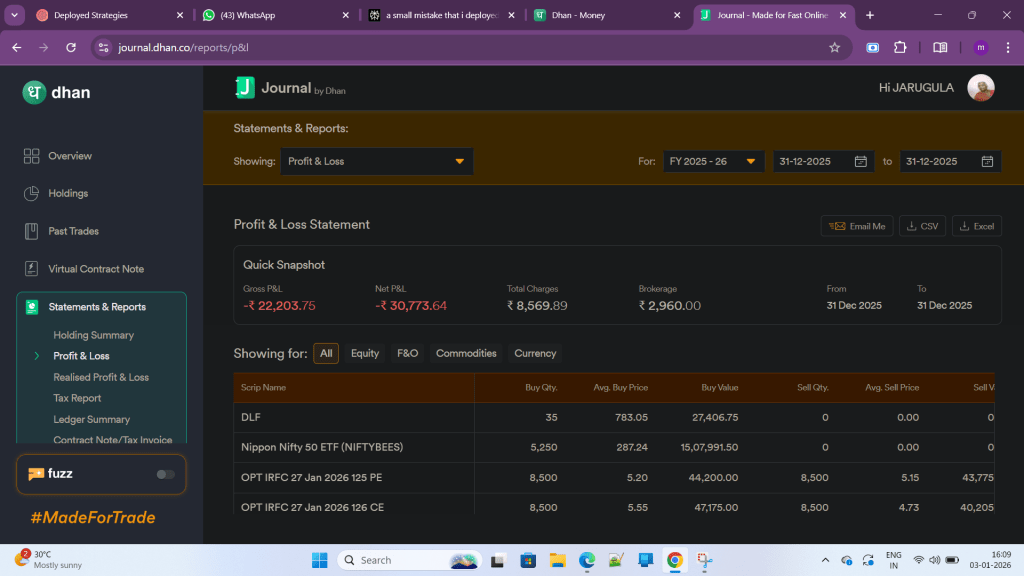
  • Navigating Monthly Expiry Challenges: Dhan Margin Glitch Limits Nifty Options Deployment

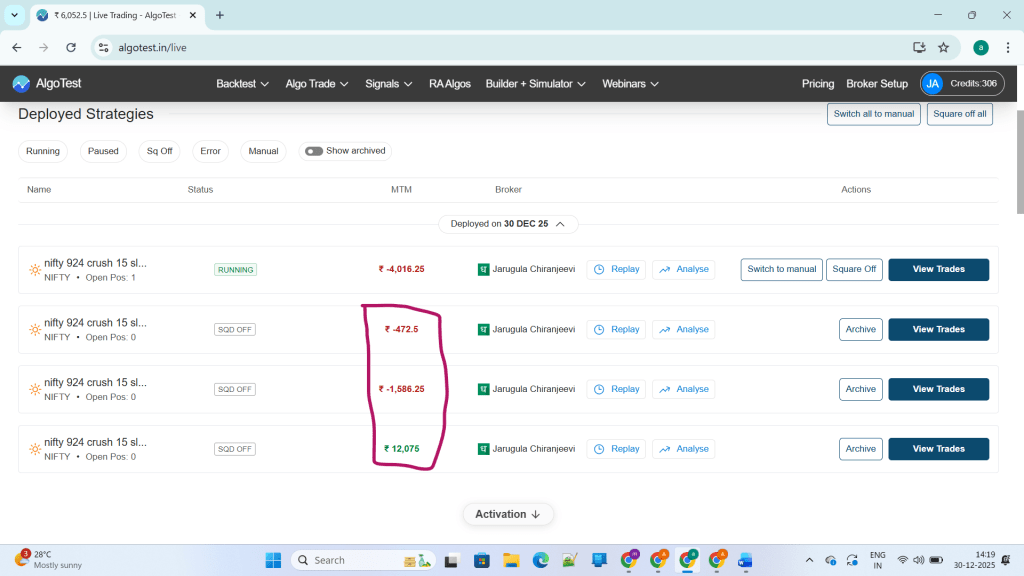
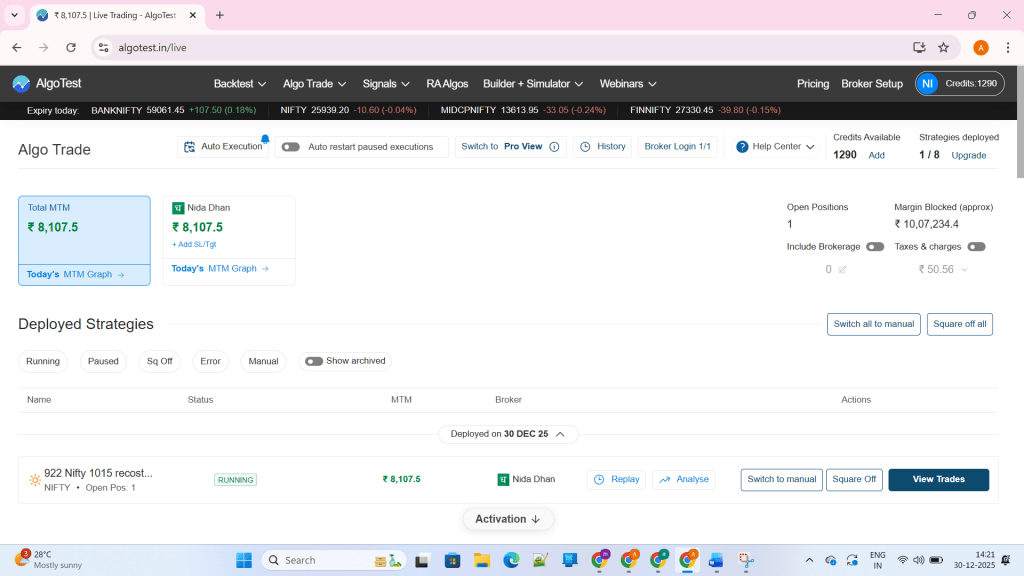
    On a monthly expiry day with no new intraday stock positions allowed, a switch to Nifty options trading revealed a frustrating margin utilization issue with Dhan broker. Despite ample pledged holdings showing as available margin, the system failed to deploy it fully, capping trades at 7 lots instead of the expected 15 based on total margin. A backtested strategy still delivered ₹12,000 in profits so far, highlighting resilience amid broker limitations.

    Pledged Holdings Margin Not Utilized

    Pledged holdings appeared as available margin in the Dhan account but were not applied to Nifty options trades during the session. This issue aligns with common Dhan complaints around MTF and pledge shortfalls, where explicit authorization or system delays prevent seamless use across segments like F&O. Traders must pledge holdings explicitly per SEBI rules, yet intraday glitches can block access despite sufficient collateral.

    Dhan vs Zerodha for Algo Trading

    Dhan offers free APIs, making it attractive over Zerodha’s ₹2,000 monthly fee, but margin reliability favors Zerodha for high-volume algo setups. Both provide similar intraday leverage (up to 5x), yet Dhan users report more pledge and shortfall issues during volatile expiry days. Zerodha’s established platform may justify the API cost for consistent margin use in Nifty options algos.

    Strategy Performance on Expiry Day

    The deployed backtested Nifty options strategy entered post-restrictions and hit ₹12,000 profits midway, proving robust for monthly expiries despite reduced lot size. Monthly expiries demand higher margins under SEBI’s 2025 rules, including 2% extra ELM on short options, which amplifies position sizing challenges. Final P&L awaits market close, but scaled-down deployment underscores the need for better broker.

    Broker Switch Considerations

    Future deployments may shift to Zerodha or alternatives  for better margin execution, weighing Dhan’s free APIs against reliability. Documenting such glitches builds empirical data for long-term broker evaluation, aligning with disciplined algo evolution.

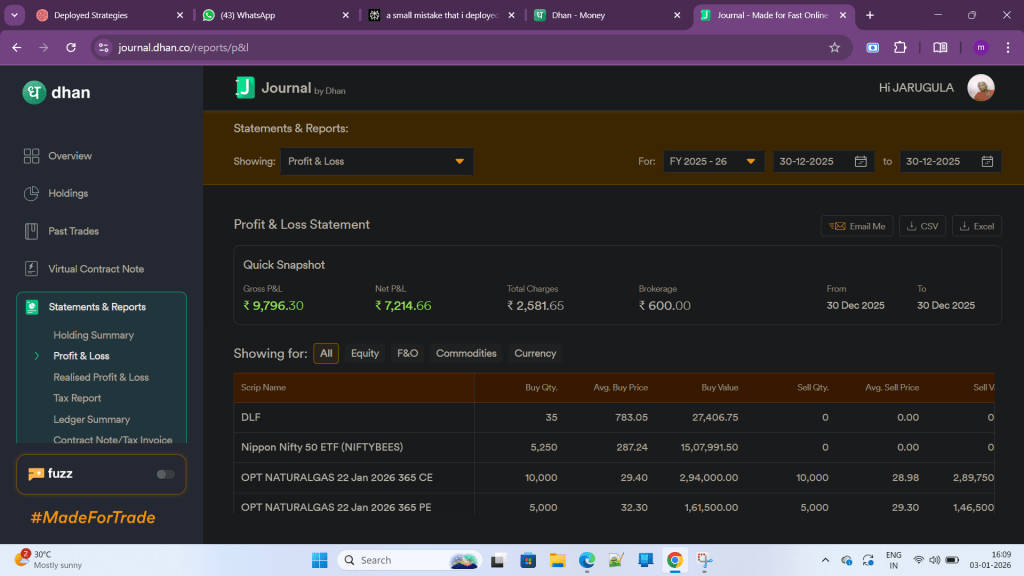
    the below screenshot is of the account for whom there is no error.


  • Extremistan Trading Triumph: Option Buys Crush Nifty 0.38% Down Day

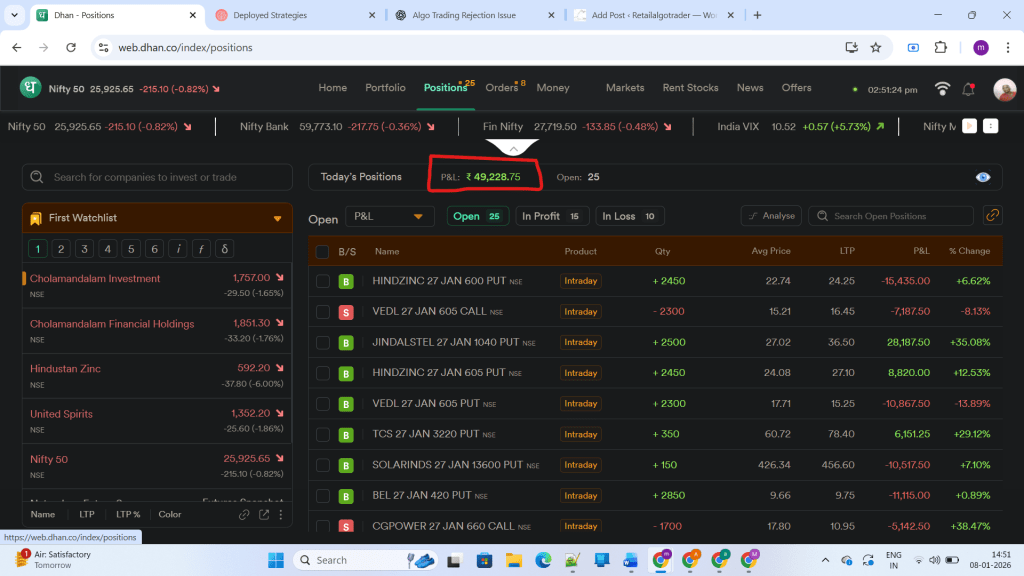
    Today’s market delivered classic Extremistan asymmetry—Nifty shed 0.38% to 25,942 amid broad weakness, yet stock option buying strategies captured massive downside convexity in HindZinc and IRFC, generating outsized profits aligning with Nassim Taleb’s barbell philosophy. MCX commodities also showed mild profits today.

    Market Breakdown

    Nifty closed down 100 points with Sensex off 346; metals reversed gains under global pressure while individual stocks decoupled sharply. Screenshot confirms HindZinc and IRFC as star performers on downside, with open profits reflecting precise entry timing. This validates option buying’s edge in fat tail events  

    Extremistan Edge

    Taleb’s framework shone: small bets on cheap OTM options explode during rare dispersions, as seen in today’s stock-specific drops versus flat index decay. My positions avoided theta bleed while convexity compounded; total P&L up despite Nifty’s 0.5% mild drag.